
A Robot Demo Should Show the Boring Parts
LIBERO-Industry puts moving objects, deadlines, and tight placement windows into a robot benchmark. The broader lesson is about the evidence a polished clip leaves outside the frame.
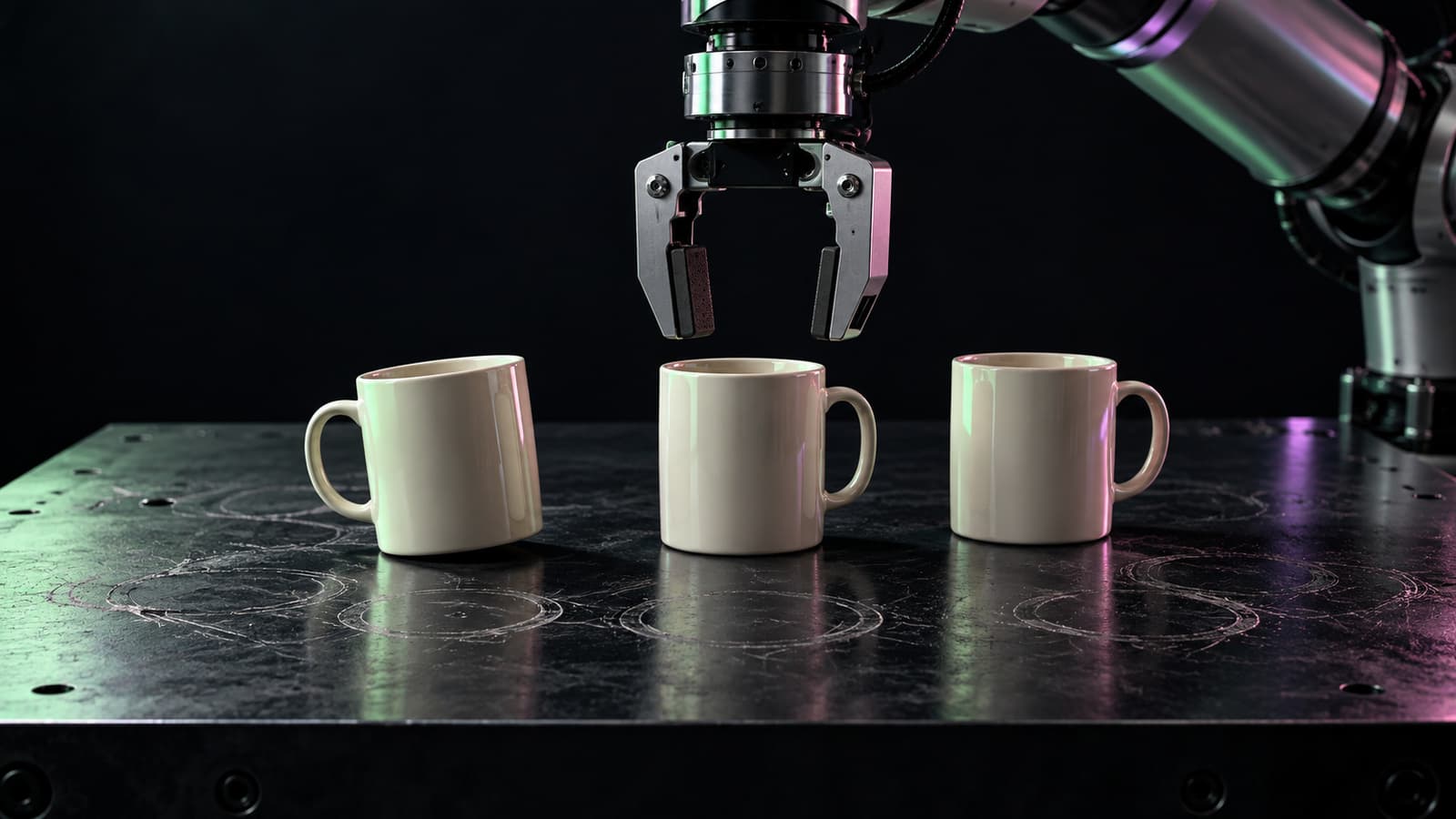
The most useful moment in a robot video may arrive after the impressive grasp. The object is on the table, the gripper is open, and somebody has to make the next attempt happen.
Does the robot find its own starting state? Does a person straighten the object? Is the next piece already moving toward the work area? Does a small delay merely make the clip less elegant, or does it mean the task has failed?
A new research benchmark gives those apparently mundane questions a more formal setting. LIBERO-Industry, submitted on October 12 and revised on October 15, studies manipulation under industrial process constraints. The authors describe 216 tasks covering loading, unloading, and transfer between static and moving locations. They vary object geometry, conveyor speed, available interaction time, and the size of the acceptable placement region. Across five evaluated generalist policies, performance deteriorated as the constraints were added and combined. These are the researchers' reported benchmark findings, not a deployment certification.
The paper's appeal is the question underneath the numbers: what happens when successfully moving an object is only part of successfully completing the job?
The task includes its surroundings
A tabletop demonstration can make a manipulation problem seem self-contained. There is an object, a destination, and an action connecting them. Real workflows often give that action neighbors.
Another piece can arrive while the robot is still working. A completed placement may need to leave room for the next operation. A recovery motion can be physically successful yet take too long for the available window. The surrounding process changes the meaning of success.
That does not make a simplified demonstration dishonest. Simplification is useful when it isolates a capability. The interpretation becomes weaker when the audience is invited to treat evidence about one capability as evidence about the whole workflow.
The practical response is to describe the boundary. Tell the viewer which parts of the task the robot controlled, which conditions were held fixed, and which events would have counted as failures. The claim becomes easier to assess without making the demonstration less interesting.
Generalization needs a visible comparison
Different kinds of evidence answer different questions. A benchmark can organize controlled changes. A diverse dataset can expose a policy to a broader range of situations. A long uncut run can reveal how a particular system behaves repeatedly in one setting.
The DROID dataset illustrates the data-diversity side of that problem. Its project describes 76,000 demonstrations collected across 564 scenes and 86 tasks, using a common robot platform. Those figures describe the dataset. They are not a success rate for a particular commercial robot, and they should not be presented as one.
For a viewer, the important habit is to ask what changed between training and evaluation. A new object, a new room, a new camera angle, and a new process constraint are different challenges. A broad claim of generalization becomes more useful when the actual variation is named.
Count the help as part of the system
Consider an illustrative example: a robot sorts mugs for an hour. A person occasionally clears a jam, returns a mug to the reachable area, or restarts a stalled sequence. The robot may still be useful. The human assistance is part of the operating arrangement that makes it useful.
A summary that reports only completed placements leaves that arrangement unexplained. A more informative account includes the number and kind of interventions, alongside the trials and their outcomes. The reader can then distinguish a supervised demonstration from a workflow that runs without routine help.
This is an editorial recommendation, not a result attributed to LIBERO-Industry. It follows from a basic question about evidence: what work happened outside the action being measured?
Resetting the scene deserves the same treatment. It may be an intentional part of an experiment, performed identically for every trial. That is perfectly compatible with careful research. It simply belongs in the explanation of what the experiment establishes.
Recovery deserves its own screen time
A flawless first attempt is easy to understand. A useful recovery can be harder to recognize because it looks hesitant: the robot stops, moves away, reobserves the scene, and tries something less dramatic.
That sequence may tell a viewer more about the system's behavior than another perfect grasp. It reveals how the robot responds when its earlier expectation no longer matches the world. It also exposes the cost of the recovery in time, motion, and human attention.
There is no universal acceptable failure rate or recovery delay for all robots. The relevant standard depends on the task and its consequences. What should travel between settings is the habit of showing the conditions and accounting for the outcomes.
Keep the claim the same size as the evidence
The original LIBERO research was designed to study knowledge transfer in lifelong robot learning. LIBERO-Industry extends the evaluation conversation toward constraints that surround an industrial action. Neither should be reduced to a cinematic contest between impressive clips.
For anyone watching the next demonstration, the useful questions remain ordinary. How many attempts were there? What changed? Who helped? What happened when the first action failed? Was completion defined before the run?
The boring parts make those answers visible. They give a promising capability a context, and give the audience a way to tell exactly how much progress it represents.
Cover: AI-generated editorial illustration.