
A Two-Armed Robot Launched to Repair Satellites Built to Be Unfixable
Northrop's Mission Robotic Vehicle carries the first dexterous servicing arms to geosynchronous orbit — and the trick that makes it work is a bolt pattern every satellite already has.
Every satellite in geosynchronous orbit was designed on the same assumption: nobody is coming. No mechanic, no fuel truck, no spare parts. Whatever you launch is what you have, and when the propellant runs out — often while every instrument aboard still works perfectly — the spacecraft is boosted to a graveyard orbit and written off. Billions of dollars of functioning hardware has been discarded this way for the sole reason that it ran out of gas.
On July 21 at 5:15 p.m. EDT, a Falcon 9 lifted off from Space Launch Complex 40 at Cape Canaveral carrying the machine built to break that assumption. Northrop Grumman's SpaceLogistics division launched the Mission Robotic Vehicle — the MRV — alongside three Mission Extension Pods. The booster, B1069, flew its 32nd and final mission putting it up.
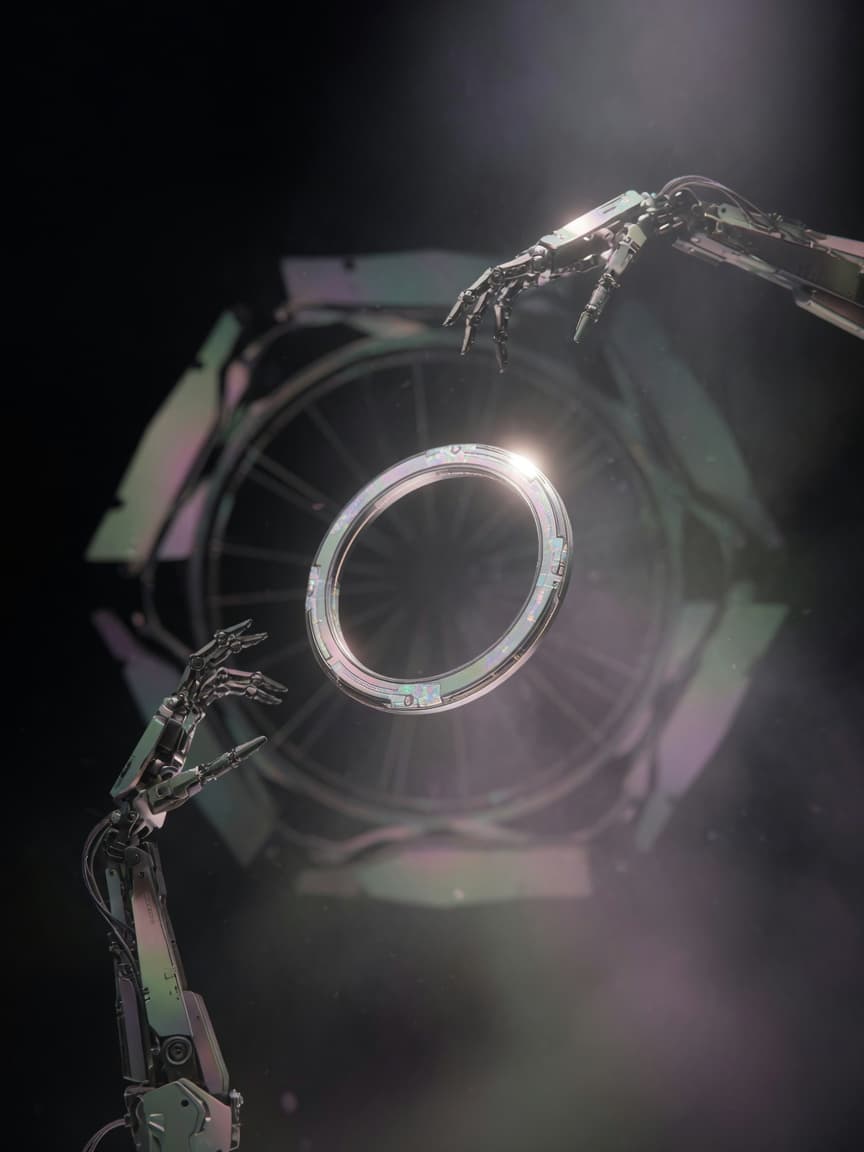
The MRV is the first spacecraft sent to geosynchronous orbit with genuine dexterous manipulation: a pair of robotic arms, built by Alliance Spacesystems, carrying an array of interchangeable tool attachments. It is designed to work for a decade, and it will spend roughly its first year simply climbing to the orbit where the work is.
Twenty years of programs, one insight
The arms are the visible part. The idea underneath them took two decades and three DARPA-lineage programs to reach flight.
The RSGS payload — Robotic Servicing of Geosynchronous Satellites — was developed at the U.S. Naval Research Laboratory with financial backing from DARPA, descending from the SUMO, FREND, and Phoenix efforts before SpaceLogistics was selected as integrator in 2019. That is an unglamorous amount of institutional patience for a capability that keeps almost being cancelled.
What kept it alive is a single structural observation, and it is the most elegant thing about the mission. Servicing a satellite that was never designed for servicing sounds impossible: there is no docking port, no grapple fixture, no handhold, and the exterior is a minefield of thermal blankets, delicate optics, solar arrays, and antennas that a robot arm would destroy on contact.
But every satellite ever flown shares one feature. It had to be bolted to a rocket. The launch vehicle interface plane — the structural ring where the spacecraft mated to its upper stage — is by necessity the sturdiest part of the vehicle, built to survive the loads of ascent, standardized across the industry, and almost always exposed after separation. It is a universal grapple point that nobody designed as one.
Target that ring and the problem inverts. You are no longer improvising a grip on a fragile custom spacecraft; you are docking to a known, load-bearing, near-standard interface that the entire existing fleet already carries. The addressable market becomes every satellite in orbit, retroactively.
Pods first, surgery later
The MRV is not going up to perform repairs on day one. Its first job is logistics: taking the three Mission Extension Pods it launched with and installing them on customer spacecraft. Each pod supplies station-keeping capability worth up to eight additional years of operational life to a satellite otherwise facing retirement. The first customers named are Optus of Australia and SES of Luxembourg.
This is a deliberately modest opening act, and it is the right one. SpaceLogistics already proved the core of it: the earlier Mission Extension Vehicles docked with and took over station-keeping for aging Intelsat satellites, which established that rendezvous and hard docking in GEO are operational rather than experimental. The MRV's advance is that it doesn't have to stay. An MEV becomes part of the satellite it rescues, one vehicle spent per customer. The MRV installs a small pod, undocks, and moves on to the next job — one expensive robot amortized across a fleet instead of consumed by a single client.
Beyond pod installation, the declared capability set widens considerably: inspection, relocation, repairs, and upgrades. Inspection alone changes operations, because GEO operators currently diagnose anomalies from 36,000 kilometers away using telemetry and inference. Sending a camera on an arm to look at the actual hardware converts guesswork into observation.
Upgrades are the genuinely radical entry on that list. If a robot can install a pod, it can eventually install a newer payload module — and a satellite that can accept new hardware in orbit stops being a fixed asset with a fixed capability and starts resembling something closer to a server you can re-spec.
The economics were always the point
Satellite servicing has been technically plausible for years. What made it a business is the collision of two cost curves.
A geosynchronous communications satellite costs hundreds of millions to build and launch, and its operational life is usually bounded not by component failure but by propellant. Extending a working asset by eight years is enormously cheaper than replacing it — provided the servicing vehicle itself isn't as expensive as a new satellite. That was the historical trap: single-use servicers priced like the spacecraft they saved.
A reusable robot that services many customers escapes the trap, which is why the MRV's decade-long design life and its ability to undock matter more than the arms do. Ten years of jobs across multiple operators is what turns a DARPA technology demonstration into a line of business.
There is a second-order effect worth watching. Orbital debris mitigation and end-of-life disposal are becoming regulatory obligations rather than good manners, and a vehicle that can grapple an uncooperative object at a standard interface is, functionally, the same machine you would build to move dead satellites. The servicing fleet and the cleanup fleet are converging on identical hardware.
For now, a robot with two arms is spending a year climbing to a belt of expensive machines that were all built expecting no one to come. The engineering that got it there is thirty years of persistence. The insight that will make it pay is that everything up there was bolted to a rocket first — and never quite let go of the ring.