
Can AI Actually Beat the Market?
No-code strategy builders and quant platforms promise an edge. Here's what survives contact with a live order book — and what's just a backtest wearing a suit.
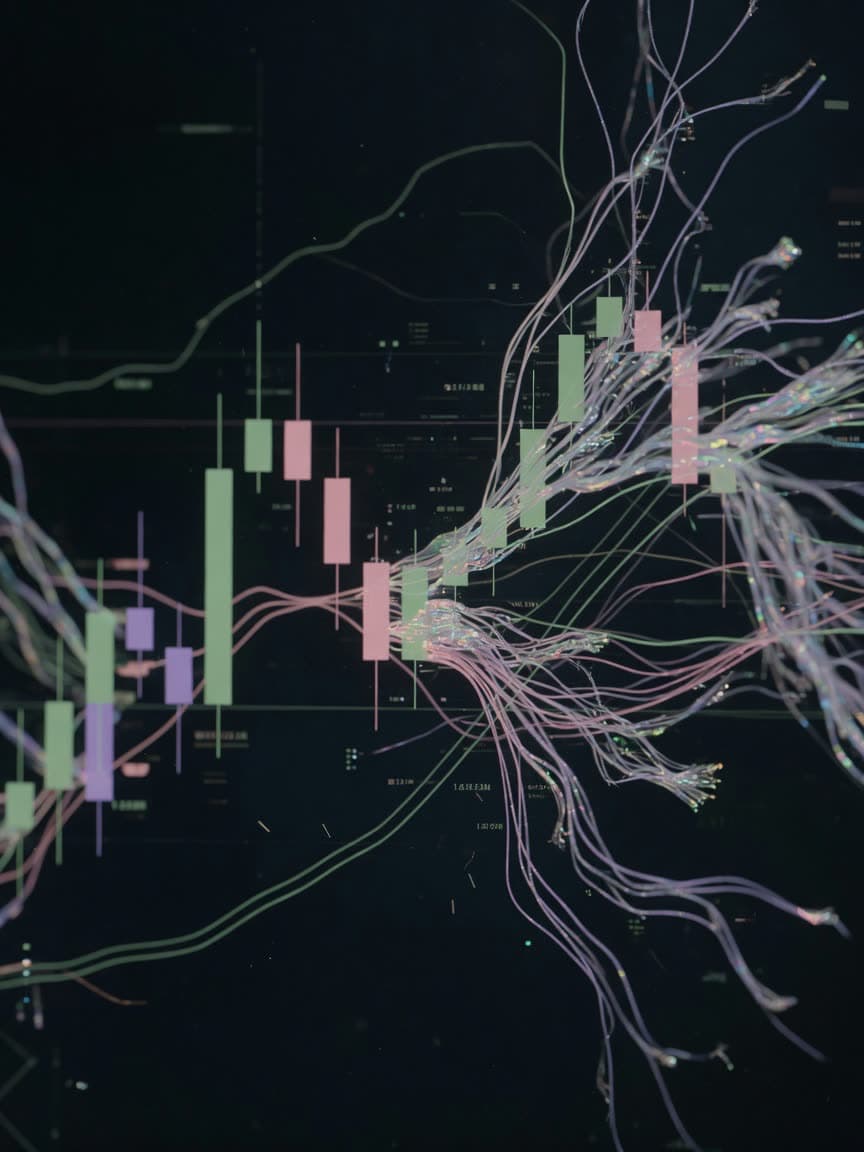
Open any trading subreddit in mid-2026 and you'll find the same screenshot: a backtest equity curve sloping up and to the right at an angle that would make Renaissance Technologies blush. Below it, a one-line caption — "built this in an afternoon with Claude." The implication is irresistible: the quant edge that hedge funds spent decades and billions assembling has been democratized, packaged into a chat box, and handed to anyone with a brokerage account.
It's a seductive story. It's also where most retail money goes to quietly die.
The honest answer to "can AI beat the market" is yes, no, and it depends what you mean by AI, beat, and market — and the gap between those three readings is exactly where the marketing lives. Let's separate the machinery that actually moves edge from the machinery that just moves subscriptions.
The no-code layer: real tools, oversold dreams
The most accessible tier is the strategy builder. Composer is the category's clearest example — a drag-and-drop (now mostly prompt-to-strategy) platform where you describe a rules-based "symphony," it codes the logic, backtests it against historical data, and will trade it live in a connected account. Reporting around the company has put its assets under management in the hundreds of millions, which tells you the demand is real even if the alpha is contested. Competitors like Capitalise.ai, Tradetron, and a wave of GPT-wrapper "build-a-bot" sites occupy the same shelf.
Here's what these tools genuinely do well: they collapse the distance between an idea and a tested implementation. A momentum-rotation strategy that once required Python, a data subscription, and a weekend now takes a paragraph. For systematizing discipline — removing the panic-sell, enforcing the rebalance — they're legitimately useful. A rules-based AI that doesn't let you override it at 3 a.m. is worth something.
Here's what they don't do: manufacture edge you didn't bring. Every backtest is a curve fit until proven otherwise, and a natural-language builder makes overfitting frictionless. You can generate a hundred variations of a strategy in an hour, keep the one with the prettiest 2015–2024 curve, and you've done nothing but data-mine noise.
A no-code builder doesn't give you a quant's edge. It gives you a quant's footguns at consumer speed.
The platforms know this. The good ones now ship out-of-sample warnings, Monte Carlo stress tests, and "this strategy is overfit" nags. Use them. Treat any curve that didn't survive a walk-forward test as fiction.
The quant tier: where the real machine lives
Move up a floor and the picture changes. Platforms like QuantConnect and the late, lamented Quantopian lineage give you institutional-grade data, a research environment, and brokerage connectivity — but they demand you actually be a quant. This is where AI is genuinely reshaping the workflow: builders are using Claude and GPT-class models as a research copilot — generating feature ideas, writing the vectorized backtest, catching look-ahead bias in their own code, sanity-checking statistics they'd otherwise fudge.
That's the underrated story of 2026. The frontier models didn't hand retail a money printer; they compressed the learning curve of quant research from years to months. Someone who understands the difference between in-sample and out-of-sample, who respects transaction costs and slippage, can now iterate at a pace that used to require a desk and a Bloomberg terminal.
The institutions, meanwhile, are several leagues ahead and pulling away. Two Sigma, Renaissance, and the systematic desks at the big banks have spent years on the things that actually matter — alternative data, execution infrastructure measured in microseconds, and the unglamorous war against transaction costs. Their edge was never the model architecture. It was data nobody else has and execution nobody else can match. A retail trader with a $200 ChatGPT-class subscription is not competing on that field.
What "signal" tools are really selling
Then there's the signal-and-sentiment tier — services that scrape filings, earnings calls, social sentiment, and options flow, run an LLM over it, and surface "AI-detected" trade ideas. Platforms layering language models over alt-data feeds, options-flow scanners, and the sentiment-analysis cottage industry that metastasized after the meme-stock era.
Some of this is real. LLMs are genuinely good at parsing the tone of a 10-K or an earnings transcript faster than a human analyst, and there's published research suggesting language-model sentiment carries short-horizon predictive signal. The problem is that carries signal and carries signal net of fees, slippage, and the thousand other funds running the identical scan are very different claims. The moment a signal is productized and sold to a mailing list, its half-life collapses. You are, by definition, not early.
If the edge fit in a subscription you could buy, the edge was already arbitraged by the time you got the email.
The tell for marketing-grade products is uniform: glossy backtests, no live track record, no disclosure of drawdowns, and a conspicuous silence about what happens after fees. Demand the live, after-cost, multi-year track record. Its absence is the answer.
The realistic retail edge
So where does that leave an actual person with an actual account? With a smaller, less cinematic, and genuinely real opportunity.
The retail edge is structural, not predictive. You are small enough to trade instruments and capacity-constrained niches that no fund will touch — you don't move the market when you buy. You have no investors demanding quarterly performance, so you can hold through a drawdown that would get a pro fired. You can be patient in a way that is structurally unavailable to anyone managing other people's money. AI sharpens all three: it lets you research faster, systematize your discipline, and remove the emotional leaks that cost retail traders far more than any missing alpha factor.
What AI will not do is turn a coin-flip strategy into a winner, or substitute for understanding what you're trading. The traders quietly compounding with these tools all share one trait — they treat the AI as a tireless junior analyst that needs everything double-checked, not an oracle that prints money.
Can AI beat the market? The model can't. A disciplined person using the model as a research multiplier, trading where the giants can't be bothered to look, occasionally can. The afternoon-backtest crowd will keep posting their curves. The ones who survive are too busy stress-testing to screenshot.