
The Drone Wars Are Already Here — and the Battlefield Is Everywhere
From DARPA's 500-unit swarm containers to Zipline's 2-million-delivery milestone, autonomous drones are collapsing the line between defense tech and last-mile logistics.
In January, Zipline landed its two-millionth commercial drone delivery. In March, the Pentagon announced a $100 million swarm challenge — Swarm Forge — promising to package integrated drone swarms for operational military units in under 90 days. In May, Defense One reported the FY2026 budget carves out $54 billion for autonomous warfare systems, with $9.4 billion earmarked specifically for unmanned aerial vehicles.
These are not separate stories. They are the same story, playing out across two domains simultaneously: the sky is getting crowded, and the machines are learning to navigate it without us.
The Pentagon's Swarm Moment
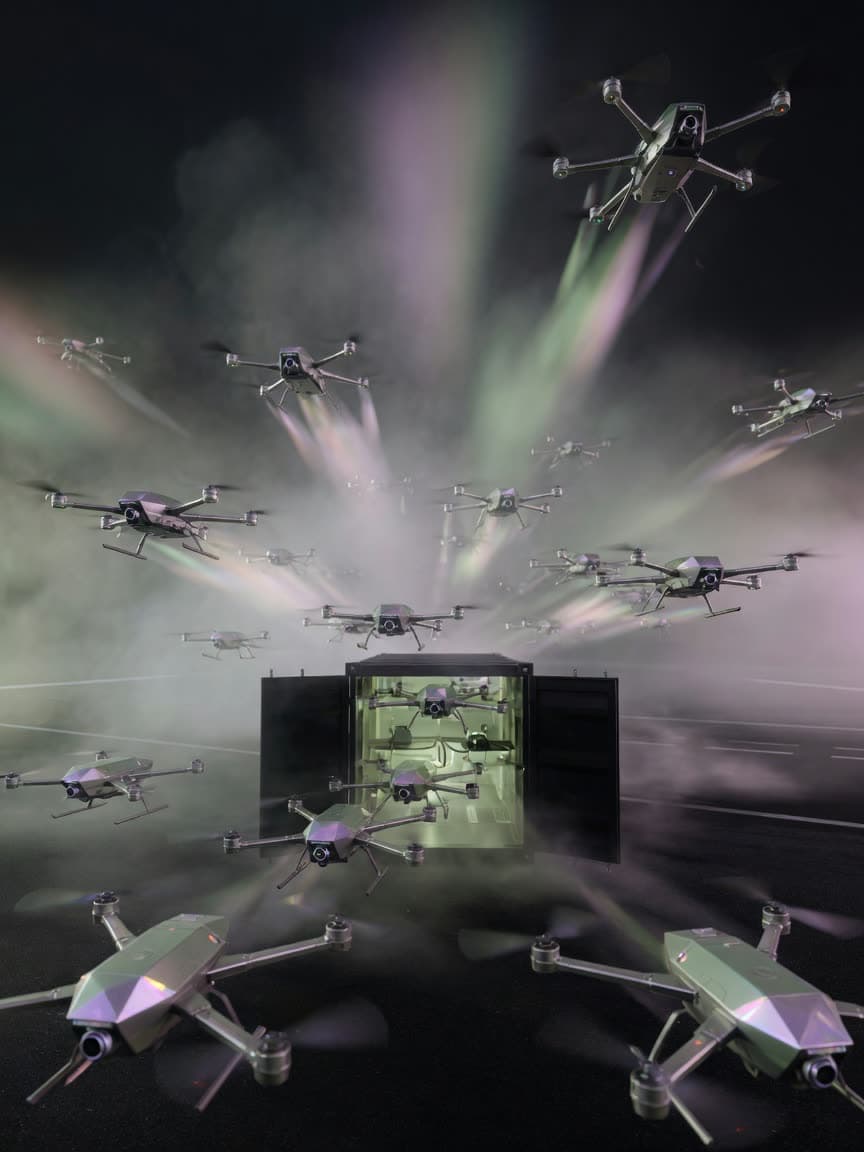
DARPA's latest solicitation is not subtle about what it wants. The program asks for autonomous containers — nondescript, shippable boxes — capable of housing, launching, recovering, and recharging constellations of up to 500 drones with minimal human input. The target is Autonomy Level 4: operators define the mission objective; the system handles everything else, including in-flight replanning, collision deconfliction, and dynamic task allocation across the swarm.
Shield AI's Hivemind software is already being integrated into the military's Low-Cost Uncrewed Combat Attack System (LUCAS), and the Air Force has tapped both Shield AI and Collins Aerospace to build the autonomy stack for its Collaborative Combat Aircraft program — with flight testing on Anduril's YFQ-44A expected imminently. The architecture being built here is not remote-controlled aviation. It is multi-agent coordination at scale, running on hardened edge silicon, designed to survive contested comms environments where a link to a human operator is a liability.
China is not waiting. In late March, state media showed off ATLAS, a swarm operations system built around the Swarm-2 ground vehicle, capable of deploying 48 fixed-wing drones and coordinating up to 96 simultaneously — with onboard AI handling target identification and strike sequencing. The swarm race has a scoreboard now, and it's public.
The Commercial Unlock: BVLOS Gets Real
On the civilian side, the proximate catalyst is regulatory. The FAA's proposed Part 108 rule — the framework that would replace the current waiver-by-waiver approval process for beyond-visual-line-of-sight (BVLOS) operations — is being treated by the industry as the moment the floodgates open. Instead of case-by-case approvals stretching months, Part 108 would let certified operators run ongoing BVLOS missions under standardized permits, provided their platforms meet airworthiness, Remote ID, and detect-and-avoid baselines.
The timing is not accidental. Zipline raised $600 million in January — at a valuation north of $7.6 billion — specifically to fund U.S. expansion into Houston and Phoenix, with at least four states targeted in the near term. The company is delivering tens of thousands of SKUs via Walmart partnerships, with sub-10-minute windows in live markets. Wing, Alphabet's drone arm, is scaling to 150 additional Walmart stores through 2027.
These aren't proof-of-concept routes anymore. Zipline has flown over 120 million autonomous miles. The infrastructure — launch docks, dispatch software, airspace coordination APIs — is industrializing faster than the regulatory calendar expected.
Edge AI: The Quiet Architecture Layer
The reason both the military and commercial operators are accelerating is the same: edge compute has gotten good enough, fast enough, and cheap enough to run real autonomy at the vehicle level.
Platforms like Lantronix's NDAA-compliant system-on-modules are giving drone OEMs AI perception and path-planning capabilities that don't require a cloud backhaul. That matters enormously in denied environments — whether that's a jammed battlespace or a cellular-dead delivery corridor in rural Texas. The drone either thinks for itself or it falls out of the sky.
The compute threshold that makes autonomous flight practical has been crossed. What's left is integration, certification, and trust.
DARPA's swarm constellation spec makes this explicit: 500 drones require onboard multi-agent coordination, formation management, and mission replanning. No ground station can handle that bandwidth. The AI has to live on the vehicle. Every major defense-prime and autonomy startup is racing to own that stack — and the commercial sector is watching, because the same edge-inference architecture that lets a swarm survive ECM also lets a delivery drone navigate a thunderstorm.
Who Builds the Picks and Shovels
The companies worth watching aren't always the ones with the flashiest hardware. Shield AI is the most obvious pick: Hivemind is a legitimate multi-vehicle AI pilot with real military contracts and a clear path to the CCA program. Anduril's YFQ-44A is the airframe of record for that first wave. Zipline has demonstrated operational discipline at a scale no domestic competitor has matched.
But the deeper opportunity may be in the stack beneath the stack: airspace coordination software, swarm mission planners, edge inference chips optimized for low-SWaP UAV payloads, and the detect-and-avoid sensor fusion that the FAA's Part 108 will effectively mandate for every commercial BVLOS operator. The drone delivery market is a logistics wedge; the autonomy software and sensing hardware it requires will generalize across every autonomous system category — ground robots, maritime vessels, urban air mobility.
The Pentagon's $54 billion autonomous warfare budget is the demand signal. The BVLOS regulatory unlock is the civilian parallel. Both are telling the same story about where capital should flow.
The Accountability Gap No One Has Solved
There is a problem no press release mentions. As autonomy levels climb and swarm sizes scale, the attribution question gets brutal: when a 500-unit swarm executes a strike based on onboard AI target identification, who is accountable for a misidentification? On the commercial side, when a fully autonomous BVLOS delivery drone collides with a manned aircraft because its detect-and-avoid system failed to classify an edge case, who answers?
The military is wrestling with this through doctrine — human authorization for lethal force remains policy, even as the definition of "authorization" stretches thin under swarm timescales. The FAA is trying to solve it through certification standards, demanding that detect-and-avoid systems demonstrate statistical reliability before operators get standing BVLOS permits.
Neither answer is complete. Both are being stress-tested in real deployments right now.
The drones aren't coming. They're already operating over Houston, over contested airspace in Eastern Europe, over rural test corridors in Arizona. The question that matters in 2026 isn't whether autonomous flight is real — it's whether the accountability infrastructure around it can keep pace with the machines. Based on current evidence, it cannot. That gap is where the next decade of drone policy, drone litigation, and drone architecture will be built.