
Quantum Computing Just Cleared Its Three-Body Problem
Duke and IonQ entangled three separate quantum processors over optical fiber—no local gates, no cheating. It's the unglamorous milestone that makes a real quantum network possible.
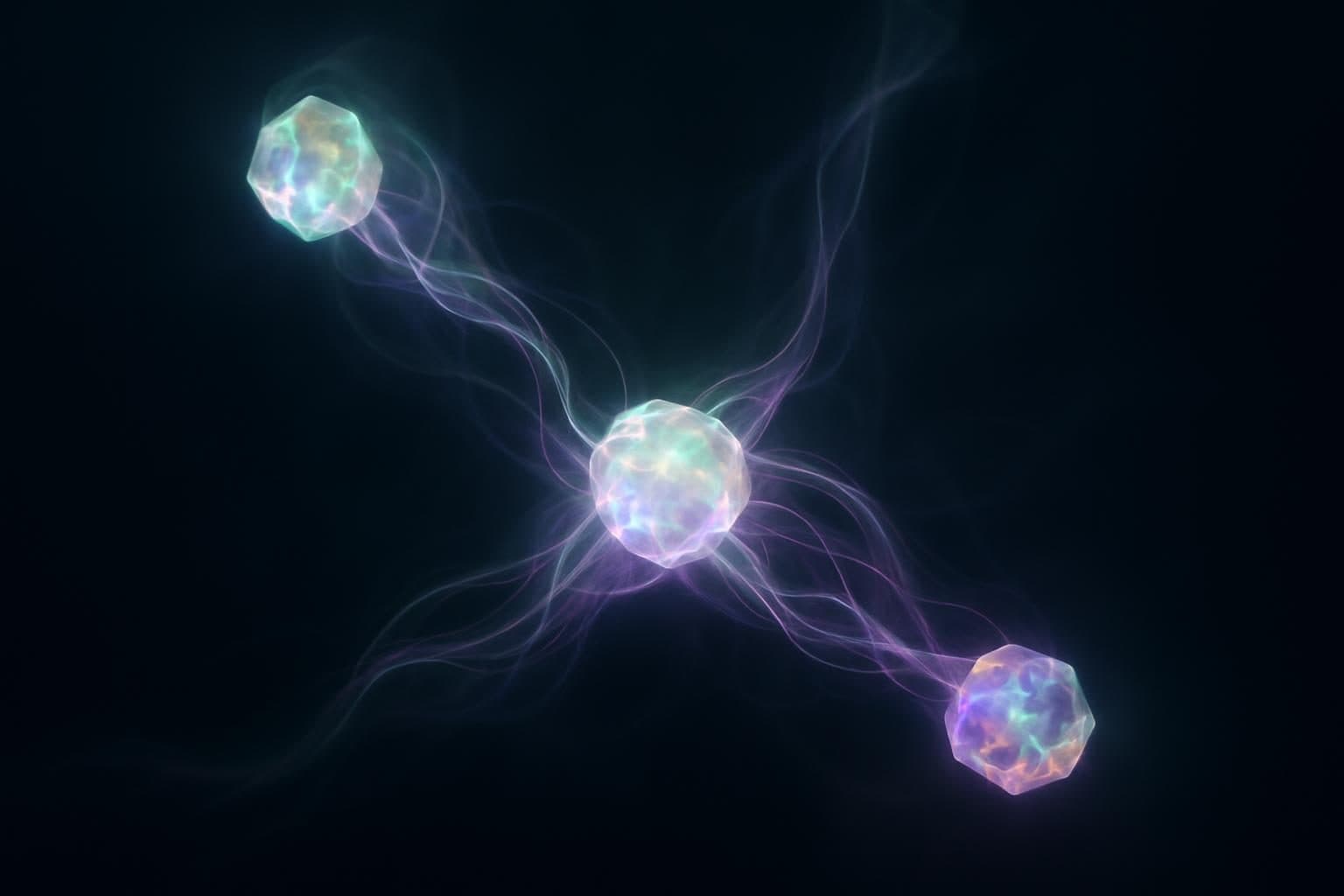
The hardest unsolved problem in quantum computing isn't building a better qubit. It's building a bigger machine. Every approach to scaling runs into the same wall: cram enough qubits into a single processor and the engineering—wiring, cooling, crosstalk, control—becomes a nightmare that gets worse faster than the machine gets better. The way out, almost everyone agrees, is to stop building one giant computer and start wiring many small ones together into a network. On June 20, 2026, researchers at Duke University and IonQ demonstrated the piece that makes that future plausible.
What they actually did
They entangled three physically separate quantum modules into a single shared quantum state. Each node held one trapped barium ion—a 138Ba+ qubit confined in a four-rod Paul trap—and the three modules sat roughly two meters apart, linked by three-meter optical fibers running to a central station that generated a shared GHZ state across all three. The result: genuine tripartite entanglement stretched across three independent machines, with the qubits in each node correlated to the others as if they were part of one device.
The verb that matters is remote. These weren't three qubits sitting side by side in the same chip. They were three separate pieces of hardware, connected by light, made to behave as one quantum system. That's the elementary operation a quantum network is built from, and it had never been shown across three atomic nodes in this clean a way before.
Why "no local gates, no post-selection" is the whole story
The caveat hidden in the announcement is actually its biggest claim. The team achieved this entanglement without local two-qubit gates and without post-selection. Both phrases are doing heavy lifting.
"Without local two-qubit gates" means the entanglement was created purely through the photonic link between nodes—not assembled by entangling qubits within a single processor first and then stitching them. The network connection itself did the work. That's the honest version of distributed quantum computing; anything else is partly a single machine wearing a network costume.
"Without post-selection" is the more important guarantee. Post-selection is the polite scientific term for throwing away the runs that didn't work and reporting the ones that did. It's a legitimate technique for proving a phenomenon is possible, but a useless one for building anything, because a real computer can't discard the trials where it failed. By reporting results without post-selection, the team is claiming the entanglement was produced on demand, deterministically enough to count—the difference between "we caught it happening" and "we can make it happen."
The numbers are honest, which is the point
This is not a press release dressed as a result, and the figures show it. The shared state landed at a fidelity between roughly 0.84 and 0.88—good enough to be unambiguously real entanglement, not yet good enough to run deep computations across the link. The entanglement generation rate was about 0.095 per second: slow, on the order of one successful linking event every ten seconds. Nobody is running an algorithm on this network tomorrow.
But the team also did the thing that separates a milestone from a curiosity: they proved the entanglement was genuinely quantum. The experiment violated the Mermin inequality while closing the detection loophole, using individually addressable atomic memories. In plain terms, they didn't just claim a spooky correlation—they ran a test that no classical explanation can pass, and they ran it without the statistical escape hatch that lets weaker experiments off the hook. The entanglement is real, verified, and certified non-local.
Why this is the bottleneck that mattered
Picture the two roads to a large quantum computer. The first is monolithic: keep adding qubits to one processor until the control hardware collapses under its own complexity. The second is modular: build small, high-quality processors and connect them with quantum links, the way classical supercomputers are racks of ordinary machines lashed together by a fast network. The modular road is the one with a future—but it only exists if you can entangle qubits across modules with enough quality and reliability to be useful. That link is the long pole.
Trapped-ion systems like IonQ's are unusually well-suited to this, because ions naturally emit photons that can carry entanglement down a fiber, making them native to networking in a way some rival qubit types aren't. Going from two linked nodes to three is not a trivial increment, either. Two-party entanglement is a connection; three-party GHZ entanglement is a genuine shared resource, the smallest version of the multi-node states a real quantum network would distribute as its basic currency.
The honest horizon
Restraint is warranted. Fidelity in the mid-eighties and a sub-one-per-second linking rate are laboratory numbers, not data-center numbers. There is hard, grinding work between this demonstration and a useful distributed quantum computer—pushing fidelity into the high nineties, raising the rate by orders of magnitude, and scaling past three nodes without the quality falling apart. None of that is guaranteed, and the field has a long record of milestones that didn't generalize.
What changed on June 20 is narrower and more durable than hype: the architecture that everyone is betting on for scale just got a clean, loophole-closed, post-selection-free proof of its core operation across three machines. The error floor in single processors is being attacked from one direction; the wall between processors is being attacked from another. This is the quiet side of the quantum race—not a flashier chip, but the plumbing that lets the chips become a network. The plumbing just held.