
Google DeepMind's Genie Story Turns a Sketch Into a Playable Game in Minutes
DeepMind's new multimodal model generates complete games—art, physics, interaction logic—from text and drawings. It's the clearest signal yet that game authorship is being restructured from the ground up.
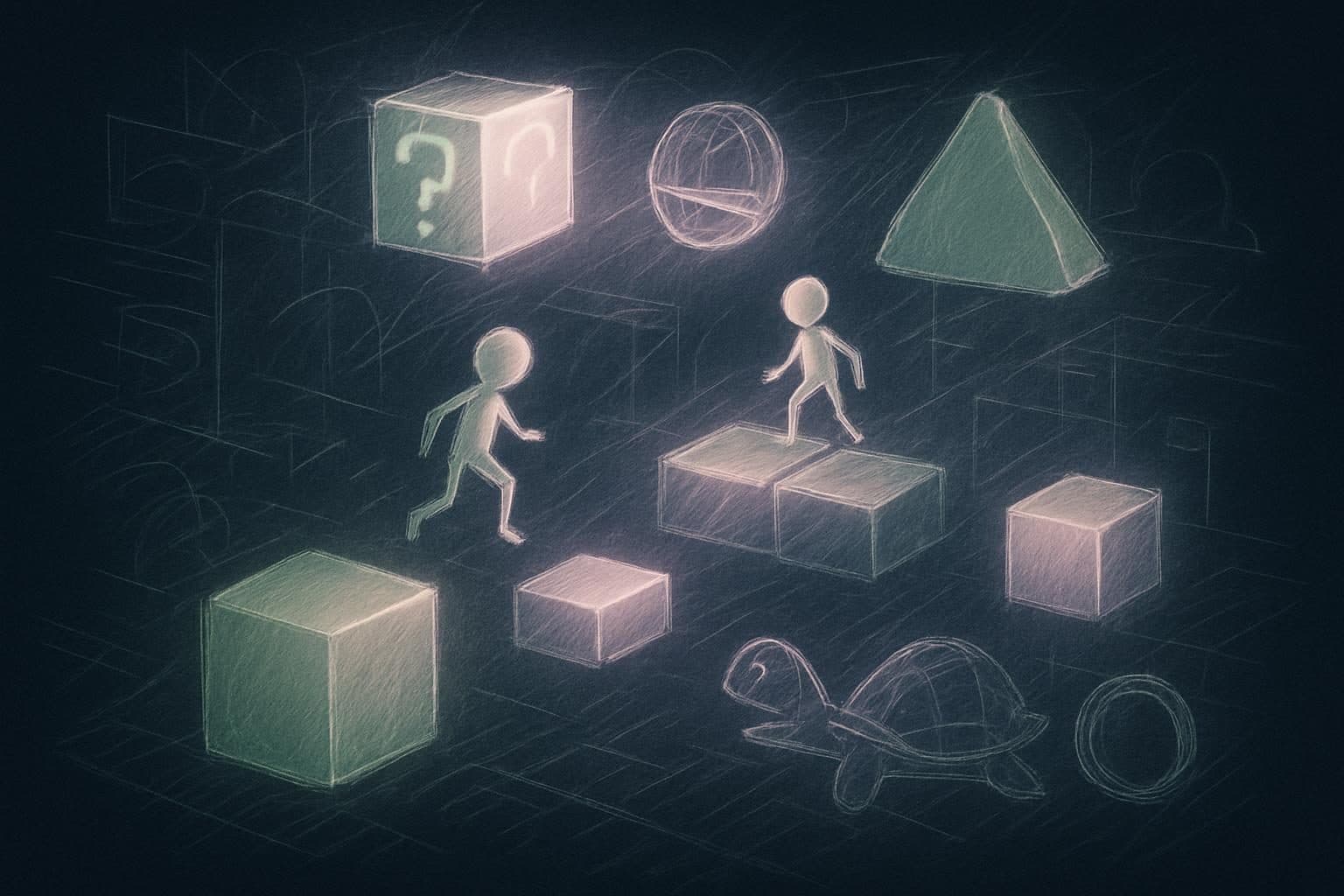
The design tools that defined game development for decades—sprite editors, physics engines, scripting layers managed by teams over months—just got a serious challenge. Google DeepMind has announced Genie Story, a multimodal generative model that produces a complete playable game from a text prompt, a rough sketch, or a reference image. Art assets, basic physics, and interaction logic are generated end-to-end, in minutes.
That is not a demo benchmark. That is the proposed default workflow.
What Genie Story Actually Does
Genie Story extends DeepMind's earlier Genie research, which focused on generating 2D game environments. The new system pushes substantially further—into narrative-driven experiences with characters, levels, and mechanics produced as a unified output rather than assembled from discrete tools. The jump from environment generation to full-game generation is the meaningful one: environments are assets, but games are systems. Generating the logic that connects assets is a different class of problem.
The model is multimodal, accepting text prompts, hand-drawn sketches, and reference images as inputs. That input flexibility matters for the audience DeepMind is explicitly targeting: indie developers and educational game builders who may have strong creative instincts but limited engineering or art production capacity. A sketch on a tablet becoming a playable prototype is a fundamentally different entry point than a blank Unity project.
The Gemini Integration Is the Strategic Piece
Genie Story doesn't operate as a standalone tool. It is integrated into Google's Gemini ecosystem, which means users can combine LLM-based narrative design with generative game mechanics inside a single workflow. Write a story in a Gemini-powered interface; the mechanical structure of the game follows from the narrative logic, not from a separate engine configuration.
This is where the product positioning becomes architecturally significant. Google is not building a game engine. It is building a content creation layer that sits above traditional engines—one where the creative primitives are prompts and sketches rather than code and asset pipelines. Positioning Genie Story explicitly as part of its push into AI-native content creation tools signals that Google sees this layer as a durable product category, not a feature.
For professional studios, the stated use case is rapid prototyping. A mechanic or level concept that would previously require a small team days to mock up could be stress-tested in a single session. Whether studios adopt that workflow depends on output fidelity and iteration control—neither of which DeepMind has disclosed in granular detail—but the directional value is legible: compress the gap between concept and playable artifact.
Limited Rollout, Open Questions
DeepMind is initially making Genie Story available to a limited set of creators and researchers, with broader public release contingent on safety and content policy testing. That sequencing is standard for a model with open-ended generative scope—games can reproduce copyrighted art styles, generate inappropriate content, or produce mechanics that embed harmful interaction patterns in ways that text-only models cannot. The content surface is wide.
What the limited rollout also does is buy time for DeepMind to observe how the tool is actually used before locking in policy guardrails. That is more useful than pre-specifying restrictions on capabilities that haven't been tested at scale. The risk is that it also delays the feedback loop that would tell DeepMind whether the output quality holds up under diverse creative inputs—sketches and prompts from thousands of users are a harder test than controlled researcher sessions.
The indie game market and educational game builders named as primary targets are also notably different audiences. Indie developers will evaluate Genie Story against existing rapid-prototyping tools and assess whether generated output is editable enough to ship. Educational builders will assess whether the tool is safe and legible for student use. DeepMind will need to satisfy both on different axes before the broader release lands with traction.
The Bigger Shift
Genie Story is the most direct evidence yet that the cost structure of game authorship is being dismantled. The skills that made game development expensive—sustained art production, physics tuning, interaction scripting—are now partially automatable from a creative brief. That doesn't eliminate studios or designers; it changes what they spend time on. The designers who understand how to direct generative systems will work at a different leverage point than those who don't.
The deeper implication is about who can make games at all. If a sketch and a paragraph can produce a playable prototype in minutes, the barrier to authorship drops to the point where the constraint becomes creative judgment, not technical access. That is a structural shift in who participates in the medium—and Google, by owning the infrastructure layer where that creation happens, is positioned to sit at the center of it.