
Humanoids Hit the Floor
After a decade of treadmill demos and backflips, humanoid robots are finally clocking shifts — but the bottleneck moved from legs to data, and the timeline to your kitchen is longer than the keynotes admit.
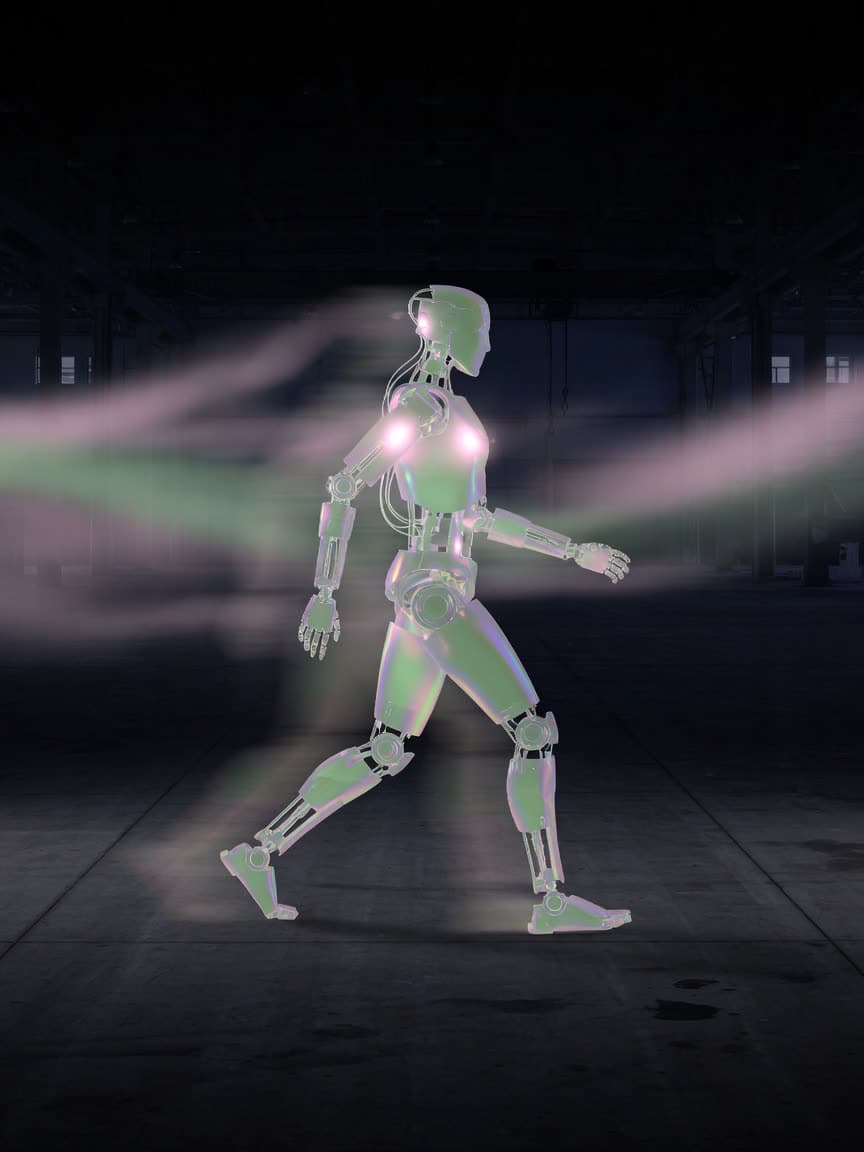
For about fifteen years, the humanoid robot was a creature of the highlight reel. Boston Dynamics' Atlas vaulting over boxes, sticking a backflip, parkouring across plywood — gorgeous, viral, and utterly disconnected from anything resembling a job. The machines could move. They just couldn't work. The gap between a robot that can leap and a robot that can pick the correct bin, every time, for eight hours, was not a gap of agility. It was a gap of cognition, and for most of the 2010s nobody had a credible plan to close it.
That changed faster than almost anyone in the field predicted. The hinge year was 2024 into 2025, and the cause was not a better leg. It was a better brain — specifically, the arrival of vision-language-action (VLA) models that let a humanoid look at a cluttered scene, parse a plain-English instruction, and generate motor commands end-to-end, without an engineer hand-scripting every grasp. By mid-2026, the question has flipped. It's no longer "can the hardware do it." It's "do we have enough data to teach it," and that question turns out to be much harder to buy your way out of.
The inflection was a software event
The honest version of the 2025–26 story starts with the realization that humanoid hardware was good enough well before the software caught up. Cheap, high-torque actuators — the muscles — stopped being the constraint. Unitree's components, Chinese supply chains, and a flood of harmonic-drive and quasi-direct-drive designs drove per-joint costs down by an order of magnitude versus the aerospace-grade legacy. You could build a competent humanoid body for the price of a luxury sedan.
What you couldn't build was a body that knew what to do with itself in an unstructured room. The unlock came from porting the transformer recipe — the one that ate language and then images — onto robot control. Google DeepMind's RT-2 and the open OpenVLA line proved the concept; Physical Intelligence's π-series and Figure's Helix turned it into a product story. The pitch is seductive and partly true: a single learned policy that maps pixels and a sentence directly to joint torques generalizes across tasks the way a language model generalizes across prompts. Show it enough examples of "put the cup in the dishwasher" and it starts handling cups it has never seen, in kitchens it has never visited.
The leg problem was solved by engineering. The hand problem is being solved by data — and data does not obey Moore's Law.
That distinction is the whole game. Locomotion is a tractable controls problem with clean reward signals; reinforcement learning in simulation cracked it. Dexterous manipulation in the open world is a long tail of edge cases — the deformable bag, the slippery lid, the object half-occluded behind another — and no simulator renders that tail faithfully enough. Which is why the frontier labs are not, mostly, racing on hardware anymore. They're racing on fleets, teleoperation rigs, and the right to collect contact-rich demonstration data at scale.
Who is actually on the floor
Strip away the demo videos and a smaller, realer picture emerges. The deployments that exist in mid-2026 are overwhelmingly in structured industrial settings — warehouses, logistics, and automotive manufacturing — where the environment can be partially controlled and the task menu is short.
Figure remains the loudest credible name, with units running material-handling and assembly-adjacent tasks inside a BMW facility, and its Helix model as the differentiator. Agility Robotics has the most boring and therefore most believable story: Digit, a purpose-built bipedal hauler, moving totes in fulfillment pilots — a robot that deliberately does not try to do everything. Amazon continues to test Digit-class machines while quietly betting harder on the non-humanoid arms that already do the bulk of its automation. Tesla's Optimus is the wildcard: Musk's timelines and production claims run years ahead of any independently verified capability, and the gap between the staged demos and the autonomous reality remains the most-litigated question in the sector. 1X is chasing the home with its soft, tendon-driven NEO, and Apptronik's Apollo is in Mercedes and logistics trials.
The pattern across all of them: pilots, not deployments. Pilots are where robots go to be supervised by three engineers per unit. The metric that matters is not "does it work in the video" but the unglamorous one the industry now obsesses over — autonomy rate, the fraction of task-time the machine runs without a human catching a mistake or driving it directly. Honest numbers are climbing but still far from the lights-out figure that would justify the valuations.
China is setting the price floor
The most consequential dynamic of 2026 isn't a capability race. It's a price war, and Unitree started it. By shipping the G1 humanoid at a five-figure price point — a fraction of what Western developer units cost — Unitree reframed the entire market. It put a capable bipedal platform in the hands of every university lab and startup that could never afford a research Atlas, and it detonated the assumption that the humanoid body would stay expensive long enough for Western firms to monetize it.
When the body becomes a commodity, all the margin migrates to the brain — and China understands the body is already a commodity.
This is the strategic fault line. The US-aligned bet is that the defensible asset is the policy — the proprietary VLA model, the fleet data flywheel, the autonomy software — and that hardware will be a thin-margin substrate. China's bet, backed by industrial policy and a manufacturing base that already dominates motors, batteries, and reducers, is that owning the supply chain and crushing the unit cost wins by default, and that good-enough open models will commoditize the brain too. Unitree, UBTech, Fourier, and a long bench of fast-followers are executing that thesis at a velocity Western hardware teams cannot match. The American advantage is in the data and the frontier models; the open question is how long that advantage survives contact with a competitor willing to sell the body at cost.
The bottleneck nobody can buy their way past
Here is the uncomfortable core of the whole field: the limiting reagent is real-world manipulation data, and there is no internet-scale corpus of it. Language models trained on the entire web. Robots cannot, because the web does not contain billions of examples of fingers exerting precise force on physical objects with proprioceptive feedback.
So the industry improvises, and every approach has a tax. Teleoperation — a human in a mocap rig or VR headset puppeteering the robot — produces the gold-standard contact-rich data, but it's slow, expensive, and doesn't scale past the headcount you can hire. Simulation is cheap and infinite but suffers the sim-to-real gap, especially for friction, deformation, and contact dynamics. Human video (learning from people doing tasks on camera) is abundant but lacks the action labels and force readings the policy actually needs. The frontier players are stacking all three and praying the curves bend the right way.
This is why the smart money in 2026 reads less like a robotics thesis and more like a data-infrastructure one. Capital is still pouring in — Figure, Physical Intelligence, Skild, and the rest have raised at valuations that price in a future not yet shipped — but the operators who'll matter are the ones building the collection apparatus: the teleop farms, the deployed fleets that phone home every grasp, the simulation pipelines. The flywheel, if it spins, spins on data. Whoever gets fleets into real workplaces first doesn't just earn revenue. They earn the only training set that matters.
The home is a decade, not a demo
Which brings us to the question every keynote dangles and every honest engineer dodges: when does this thing fold your laundry?
Not soon. The home is the hardest possible environment — unstructured, unpredictable, safety-critical, and utterly unforgiving of the long tail of edge cases that warehouses are specifically designed to eliminate. The robot that thrives in a fulfillment center, where the floor is flat and the totes are uniform, is years of capability away from the robot that can be trusted around a toddler and a flight of stairs. The optimists selling 2027 home robots are selling the demo, not the deployment.
The realistic arc: manufacturing and logistics through the late 2020s, where the economics already pencil out and the environment cooperates. Constrained commercial settings — back-of-house retail, hospitality, eldercare-adjacent tasks — in the early 2030s. The general-purpose home robot, the one from the science fiction, somewhere past that, gated not by hardware but by the slow, expensive accumulation of the data that teaches a machine the physical world.
The humanoids have, at last, hit the floor. They're clocking shifts, moving totes, surviving pilots. That's a genuine inflection, and the skeptics who spent a decade right about the backflips should update. But the floor they hit is a warehouse floor — flat, mapped, and built for machines. The kitchen floor is still a long walk away.
The legs were the easy part. We just spent fifteen years finding that out.