
Humanoids Stopped Demoing at WAIC and Started Clocking Shifts
AgiBot's A3 Ultra leads a wave of Shanghai reveals where every headline number is about runtime, charging, and uptime — not whether the robot can walk.
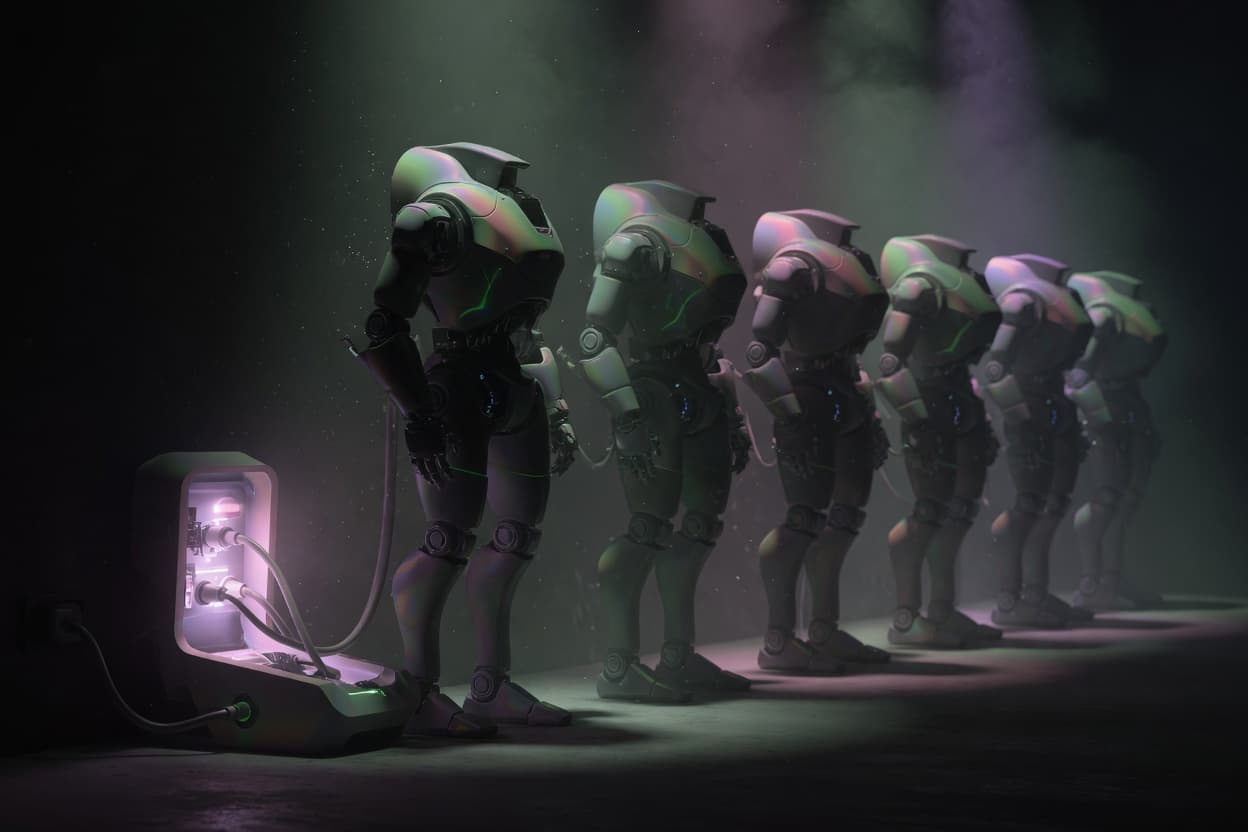
The World Artificial Intelligence Conference ran in Shanghai from July 17 to 20, and the humanoid hall produced the usual volume of hardware. What it also produced — quietly, in the spec sheets rather than the keynotes — was a change in which numbers the companies chose to lead with.
For three years the headline figure on a humanoid reveal was degrees of freedom, or gait stability, or a video of the thing doing a backflip. At WAIC 2026 the numbers that got top billing were operating hours, charging modes, and repeatability tolerances. That is not a marketing shift. That is what a category looks like when it stops selling the possibility of work and starts selling the terms of it.
The A3 Ultra is a shift worker
AgiBot unveiled four products on July 18: the A3 Ultra, the X2 Edu, the G2 Max, and the OmniHand 3 Ultra-M.
The A3 Ultra is the flagship, and its spec sheet is instructive. It stands 1.74 meters, weighs 60 kilograms, carries 51 active degrees of freedom, and lifts 5 kilograms per arm. Those are respectable but unremarkable figures for a full-size humanoid in 2026.
The interesting entries are further down. Runtime is up to eight hours of combined operating time. Compute is NVIDIA Thor. And charging is listed three ways: direct charging, battery replacement, and autonomous charging. Perception runs 3D LiDAR, RGB-D and fisheye cameras, binocular vision, plus GPS, RTK, and UWB positioning — a stack built for knowing where you are inside a building over a long period, not for a scripted demo loop.
Eight hours is a shift. Autonomous charging is what you build when nobody is going to be standing there to plug the robot in. Battery replacement is what you build when eight hours isn't enough and the floor doesn't stop. AgiBot positioned the A3 Ultra for "long-duration operation in public-facing, commercial and service environments," and for once the positioning and the hardware agree.
The G2 Max makes the same argument from the industrial side: heavy-payload force-controlled arms, omnidirectional wheeled mobility, adjustable working height, and — again — battery replacement and autonomous charging. The X2 Edu is the cheap seat, roughly 1.3 meters with 29 degrees of freedom and a 3-kilogram end-effector payload, aimed at classrooms and competitions. Seeding a development platform into universities is a slow, unglamorous, extremely effective way to own an ecosystem a decade out.
The hand is the actual bottleneck
The least discussed of AgiBot's four reveals is the one most likely to matter.
The OmniHand 3 Ultra-M is a fully direct-drive hand with 20 active degrees of freedom in 630 grams. It grips 5 kilograms whole-hand, opens or closes in a typical 0.3 seconds, and repeats to ±0.2 millimeters. It carries vision-based tactile sensors and a palm tactile array.
Every serious humanoid program eventually collides with the same wall: locomotion is close to solved and manipulation is not. A robot that can walk across a warehouse and then fumble a fastener has not automated anything. Direct-drive at 630 grams matters because tendon-driven hands are the usual compromise — cheaper and lighter, but with backlash and hysteresis that make sub-millimeter repeatability difficult to hold over thousands of cycles. Tactile sensing matters because vision alone cannot tell you that you are about to crush the thing you are holding.
±0.2 millimeters at 0.3 seconds per cycle is not a demo number. It is a number you quote when someone is deciding whether to put your hardware on an assembly line.
The spectacle is still there
Not everything at WAIC was about duty cycles. Unitree showed the GD01, which the company calls the world's first mass-produced transformable robot: 2.7 meters, 500 kilograms, able to switch between two-legged and four-legged movement and carry a person. Treat "mass-produced" as a vendor claim until units ship. It is a magnificent object and it is not obviously a product.
Meanwhile, in Shenzhen, the Ultimate Robot Knock-out Legend opened on July 17 with thirty-two teams fighting standardized EngineAI T800 humanoids for a 10 million yuan prize pool. Robot combat leagues are a marketing channel, but they are also an unusually honest hardware test — sustained impact, rapid recovery, and repair economics under real adversarial load.
The most telling demonstration sat between the two poles. Yuanli Lingji, working with StepFun, ran six robots continuously for 15 hours to assemble a 3.5-meter model of the Great Wall from more than eight components, at sub-millimeter precision.
Strip away the subject matter and that is a long-horizon, multi-agent, high-precision assembly task executed without a human resetting the scene. Fifteen hours is the interesting variable. Anyone can stage a two-minute clip. Fifteen hours surfaces thermal drift, calibration decay, battery management, error accumulation, and every failure mode that only appears once the demo has stopped being a demo.
What the numbers are actually saying
There is a reasonable amount of skepticism owed here. These are company-published figures from a trade show, "up to eight hours" is doing familiar work in that sentence, and none of it has been independently validated in a customer deployment. WAIC is a sales floor.
But the direction of the boasting is itself information. Vendors lead with the metrics they believe buyers are underwriting. Two years ago that was athleticism, because the open question was feasibility. This year it is runtime, charging autonomy, tactile repeatability, and continuous multi-robot operation — because the open question has moved to cost per hour of useful work.
That question is much harder, and much less fun to watch. It is also the only one that ends with these machines on a payroll line instead of a marketing budget.
The robots at WAIC weren't trying to impress anyone. They were auditioning.