
The Hypercar Learned to Plug In
Ferrari's F80, the Bugatti Tourbillon, Koenigsegg's freakish drivetrains, and the AMG ONE proved the same heresy: at the very top, electrification and software didn't dilute the machine. They redefined what 'fast' even means.
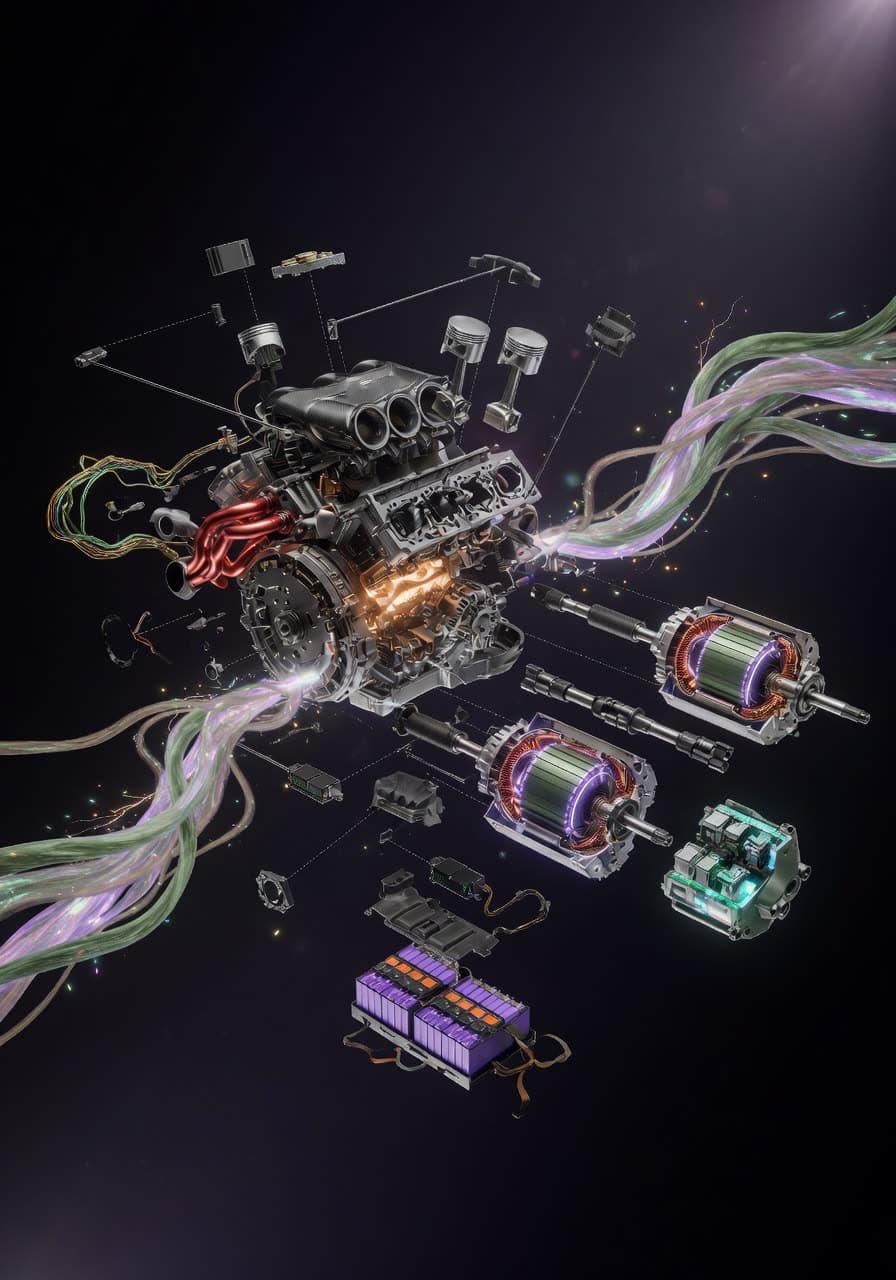
For a decade the hypercar establishment treated the electric motor the way a Michelin kitchen treats a microwave: technically useful, spiritually offensive. The combustion engine wasn't just the powertrain, it was the entire argument — the noise, the heat, the romance of controlled explosions. Then the numbers stopped agreeing. By 2026 the fastest, most expensive, most desirable cars on Earth are all hybrids, and the holdouts are the ones explaining themselves. Electrification didn't water down the apex of the automobile. It conquered it — and software came along to finish the job.
The torque-fill revelation
The thing the purists got wrong was thinking electrification was about efficiency. At this altitude, nobody cares about a kilowatt-hour. What the electric motor actually delivers is the one thing combustion physically cannot: instant, gap-free torque exactly when the engine can't make it.
Ferrari's F80, the spiritual heir to the LaFerrari and the F40 before it, is the clearest statement. It pairs a 3.0-liter twin-turbo V6 — a V6, in a flagship Ferrari, a sentence that would have caused riots a decade ago — with three electric motors for a combined output in the region of 1,200 horsepower. Two motors sit on the front axle, vectoring torque to each wheel and giving the car all-wheel-drive traction and a cornering precision no purely mechanical car can match. The electric assist also spins the turbos via an integrated motor-generator, erasing lag. The V6 isn't a compromise forced by emissions. It's lighter, and the hybrid system makes its narrowness irrelevant.
The electric motor didn't replace the engine's character. It filled in every place the engine was weak and let the engine do only what it does best.
That is the template now. The motor handles the milliseconds combustion can't.
Bugatti's defiant V16
Then there is the Bugatti Tourbillon, which set out to prove the opposite point with equal conviction. Where everyone else downsized, Bugatti — now under the Rimac-led Bugatti Rimac umbrella, a telling merger of old-world coachbuilding and new-world electric engineering — built a naturally aspirated 8.3-liter V16, designed with Cosworth, that revs to 9,000 rpm. No turbos. Then it bolted on three electric motors and a battery for a combined figure north of 1,800 horsepower.
The Tourbillon is the philosophical pivot of the whole segment made physical. Mate Rimac, who built his name on the all-electric Nevera and its brutal acceleration records, chose for Bugatti's flagship to keep the most theatrical combustion engine imaginable — and surround it with electric power rather than replace it. The man who could most credibly have gone full-electric instead made the case that the engine is the soul and electrons are the muscle. Even the dashboard rejects screens in favor of a jeweled mechanical instrument cluster built like a watch movement. It is a deliberate, expensive argument that the hybrid hypercar should feel analog and sound furious while being faster than anything before it.
Koenigsegg's drivetrain heresy
If Ferrari refined the template and Bugatti dramatized it, Koenigsegg simply ignored the rulebook. Christian von Koenigsegg's cars have always treated engineering orthodoxy as optional, and electrification handed him new toys. The Gemera, the company's "family" four-seater, has been offered with the tiny three-cylinder twin-turbo "Tiny Friendly Giant" engine and electric motors, and in its most extreme form with a twin-turbo V8 — combined outputs that crested into four-figure horsepower while seating four.
Underpinning it is Koenigsegg's "Dark Matter" electric motor and the Light Speed Transmission, a gearbox that uses multiple clutches and electric actuation to shift with a directness no conventional automatic can touch. This is the part the noise-and-romance crowd missed: the electric components didn't just add power, they made entirely new mechanical architectures possible. A motor integrated into the driveline lets the engineers delete components, blend power sources, and shift gears in ways pure combustion never allowed.
Software ate the apex, too
The quieter revolution is code. The AMG ONE — Mercedes-AMG's road car built around an actual Formula 1 power unit, a 1.6-liter turbo V6 with no fewer than four electric motors — took years longer to deliver than promised precisely because making an F1 engine idle in traffic and survive without a rebuild every weekend was a software problem as much as a mechanical one. Managing energy deployment, turbo spool, and motor coordination across street and track is now a control-systems discipline.
That logic propagates down through the whole segment. These cars run sophisticated torque-vectoring, regenerative braking blended invisibly with friction brakes, multiple drive modes that completely change the car's personality, and active aero that reshapes the bodywork at speed. The driver still matters enormously — but the car beneath them is a real-time computation, balancing four or more power sources hundreds of times a second.
A modern hypercar is a combustion engine, a battery, several motors, and a control system arbitrating between them faster than any human could. The driver feels one seamless machine. There are four arguing under the floor.
The frontier that's left
What's striking in 2026 is how thoroughly the hybrid won the top end while pure-electric hypercars — the Nevera, the Lotus Evija, the Pininfarina Battista — remain magnificent but somehow peripheral, prized for record runs more than for desire. The market, for now, decided the ultimate driver's car wants the engine kept and the electrons added. The drama, the sound, the heat: preserved. The lag, the traction limits, the torque holes: deleted.
Kicker: The purists were right that the engine was the soul. They were wrong that the motor was its enemy. At the very top of the automobile, electrification didn't kill the machine — it gave the machine everything the machine was always missing.