
Japan's Automakers Are Turning Humanoids Into a Manufactured Product
Mitsubishi Motors wants 1,000 humanoids a month off a Kyoto line by 2027. The story of the pilot is over; the story of the assembly line has started.
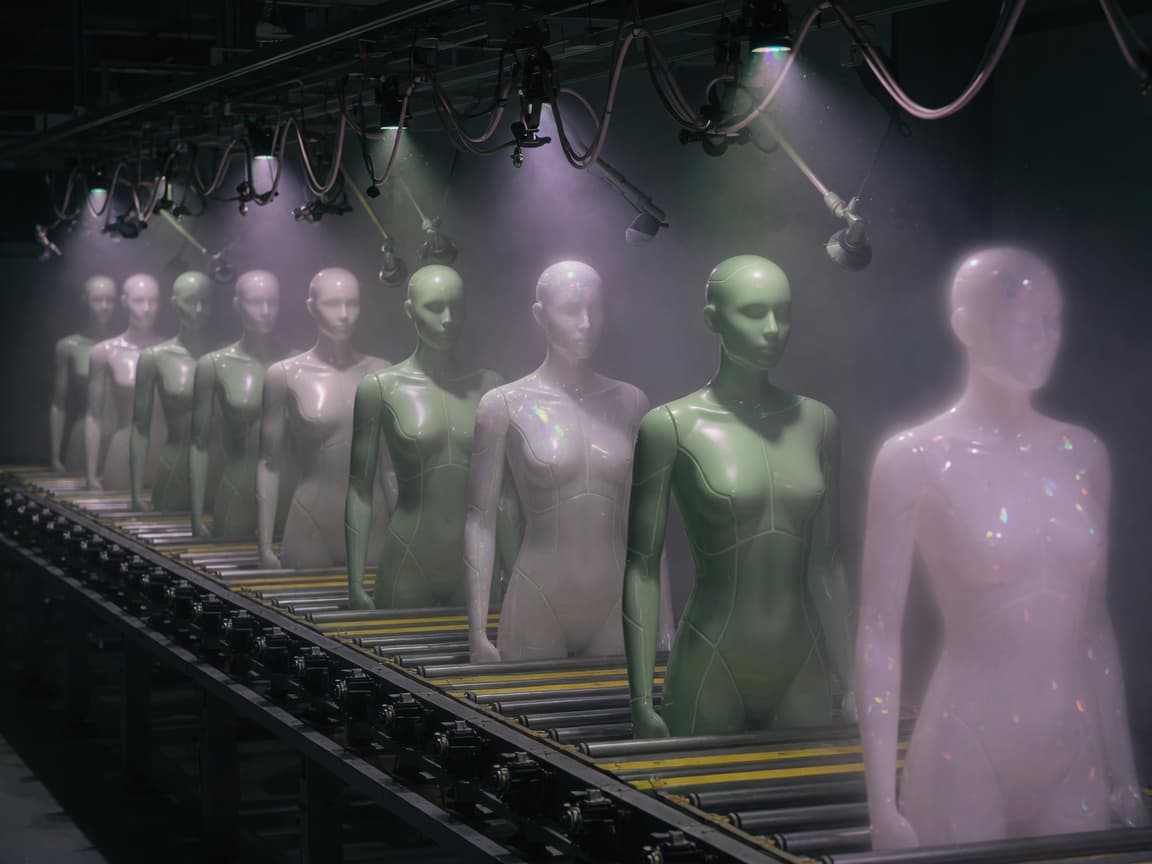
For three years the humanoid-robot story has been a demo reel: a machine folds a shirt, pours a drink, walks across a stage, and the applause stands in for a business model. The most consequential humanoid news out of Japan this month has no reel. It is a production target.
Mitsubishi Motors has signed a memorandum of understanding with Highlanders, a University of Tokyo robotics startup, to jointly develop and mass-produce humanoid robots — targeting 1,000 units per month off a line at Mitsubishi's Kyoto plant, starting as early as 2027. The robots will first work on Mitsubishi's own assembly lines before being sold commercially. Read that sequence carefully, because it is the whole point: an automaker is treating the humanoid not as a research object but as a product to be manufactured, deployed internally, and then shipped — the exact playbook it already runs for cars.
Why a carmaker, and why now
There is a reason the humanoid inflection is happening inside automakers rather than robotics labs, and it isn't the robots. It is the factories.
An automaker already owns the three things a humanoid company spends years and hundreds of millions trying to acquire: high-volume precision manufacturing, a captive deployment environment, and a workforce problem urgent enough to justify the capex. Mitsubishi doesn't have to hypothesize about where a humanoid earns its keep — it can bolt one onto its own line, measure the throughput, fix what breaks, and only then decide whether to sell it. The internal deployment isn't a marketing beat. It is the R&D loop and the quality-assurance program folded into one, run on the company's own dime and its own shop floor.
That is a categorically stronger position than a standalone humanoid startup, which has to sell an unproven machine to a skeptical buyer before it has any real deployment data. The automaker is its own first customer, its own test lab, and its own reference account. By the time the robot reaches the market, "does it actually work in a factory" is already answered — by the factory that built it.
Not one company — a wave
Mitsubishi is the clearest signal because it named a number, but it is not alone, and the breadth is the story.
Shimizu Corporation, one of Japan's largest construction firms, has moved to full-scale development of AI-powered humanoids for job sites — painting, plastering, inspection — targeting deployment around fiscal 2030. Construction is arguably a harder environment than a factory floor: unstructured, hazardous, different every day. That a builder is committing to it signals confidence that the platforms are approaching the reliability such settings demand.
Toyota is evaluating humanoids on a components line at its Aichi plant, while the Toyota Research Institute works with Boston Dynamics on the AI stack behind the Atlas robot — a partnership that pairs the world's most sophisticated hardware with one of the largest manufacturing operations on earth. Kawasaki Heavy Industries continues developing Kaleido, its 180-centimeter, 86-kilogram humanoid aimed at parts assembly and logistics. Each of these is a different bet on the same thesis: that the humanoid's first real market is industrial, indoors, and owned by the company deploying it.
The common thread is that none of them is selling a consumer dream. There is no android in the kitchen here. There is a machine doing the repetitive, ergonomically punishing, chronically understaffed work that Japan — with the developed world's most acute demographic labor shortage — cannot fill with people. The humanoid isn't a moonshot in this framing. It is a response to a spreadsheet.
The China contrast
It is worth holding this against the other humanoid capital of the world. China's push is louder and more public — Unitree and AgiBot debuting at WAIC in Shanghai, EngineAI's standardized robots throwing punches in a Shenzhen fighting league for a seven-figure purse, a domestic price war driving unit costs down fast. That approach optimizes for volume, spectacle, and cost leadership, and it is formidable.
Japan's move optimizes for something else: integration depth. A Chinese humanoid maker is selling a robot. Mitsubishi is embedding the robot into a manufacturing system it already controls end to end, which means it can co-design the machine and the workflow together rather than shipping a general-purpose unit and hoping the customer figures out the deployment. Cost leadership wins the commodity layer. Integration depth wins the high-reliability, high-mix industrial layer — and that layer is where the durable margins in industrial automation have always lived.
The tell is the target, not the demo
The reason 1,000 units a month is a more important sentence than any capability claim is that it forces every unglamorous question a demo lets you skip. A production target implies a supply chain, a cost curve, a service model, spare parts, a quality standard, and a plan for what happens when a unit fails on a live line. You cannot fake those with a good highlight video. Committing to a monthly cadence means Mitsubishi believes the answers exist — or that it can manufacture them the way it manufactures everything else.
The humanoid field spent three years proving that the machines can move. The next phase, and the one Japan's automakers just started, is proving they can be made — repeatably, affordably, at rate. That is a less thrilling problem and a far more consequential one. Nobody applauds an assembly line. They just ship the units.