
Latent Space Is a Place Artists Can Walk Through
Every image model hides a map of possible pictures. The most interesting work in machine-assisted art comes from people who treat that map as a landscape to explore, not a vending machine.
Most people meet image models through a text box. You type a sentence, you get a picture, you type a better sentence. It feels like ordering from a menu.
Underneath the menu is something stranger and far more useful to anyone who makes things: a space. Every modern image model compresses what it has learned into a high-dimensional coordinate system, usually called latent space, where each point decodes into an image and nearby points decode into images that look related. Prompts are one way to land somewhere on that map. They are not the only way to move around it, and they are rarely the most expressive one.
A map nobody drew by hand
The idea is older than the current boom. Variational autoencoders (Kingma and Welling, 2013) and generative adversarial networks (Goodfellow and colleagues, 2014) both learn to turn a compact vector of numbers into a picture. Feed in a different vector, get a different picture. Slide smoothly from one vector to another and the output morphs smoothly too, because the model has organised its knowledge so that similar things sit close together.
Language models taught the same lesson in words. Word2vec (2013) became famous for vector arithmetic: take the vector for "king", subtract "man", add "woman", and you land near "queen". Directions in the space carried meaning. Nobody labelled them. They emerged from the data.
Stable Diffusion, released in 2022, made the word "latent" mainstream. It is a latent diffusion model: instead of denoising full-size pixels, it works on a compressed representation, a 64×64 grid with four channels for a 512×512 image, and only decodes back to pixels at the end. That compression is a big part of why it could run on consumer graphics cards at all.
The walk is the work
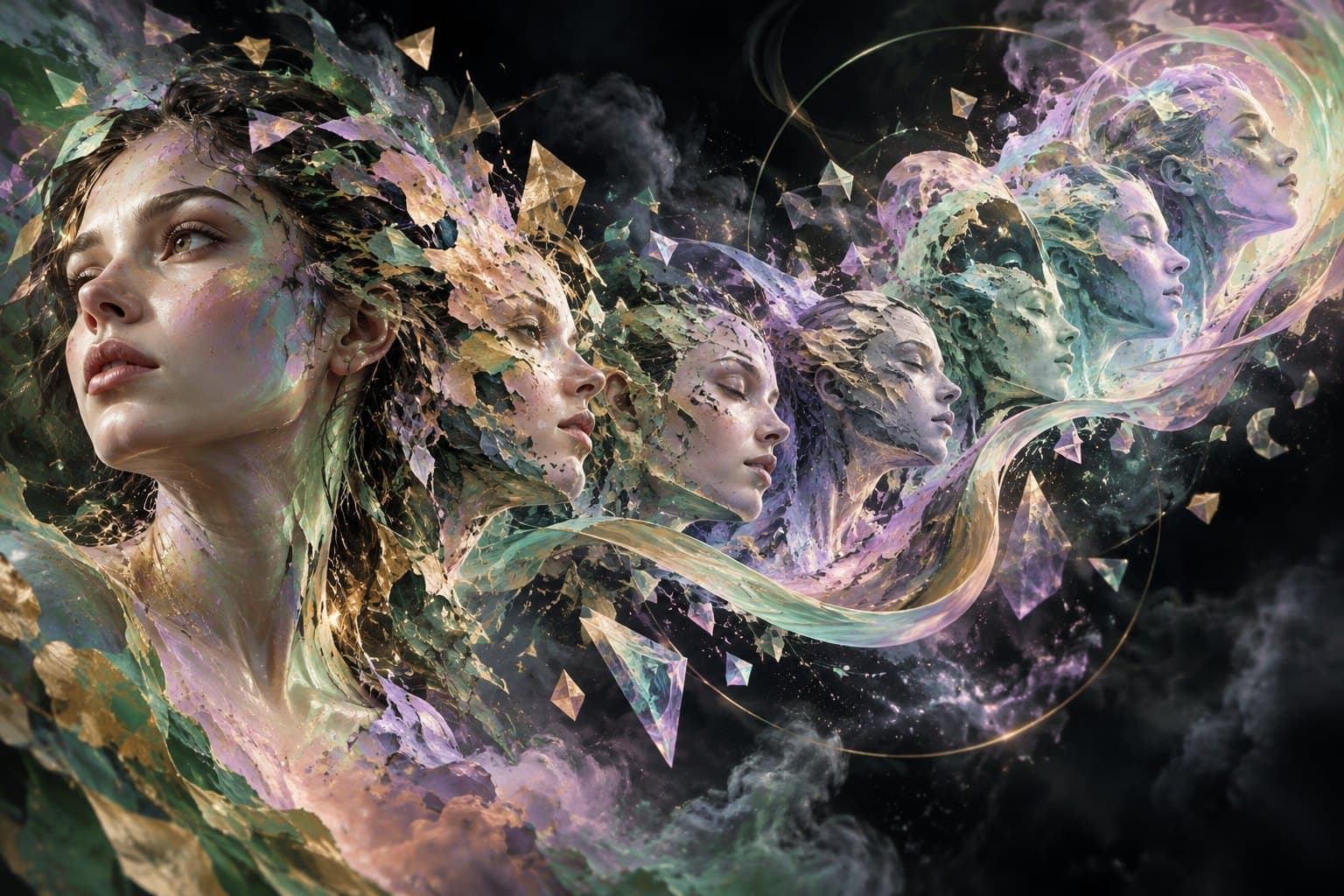
Artists noticed early that the most beautiful outputs were often not single frames but the paths between them. The "latent walk", a slow interpolation from one point to another, became a signature of the StyleGAN era: faces that age, shift and become other faces without a cut. Refik Anadol's Unsupervised, which filled the lobby of New York's Museum of Modern Art from late 2022 into 2023, was built on a model trained on the museum's own collection and shown as a continuous drift through what that model had learned. The piece was less a picture than a weather system.
That is the shift worth paying attention to. When the medium is a space, the creative decisions change:
- Where to stand. Choosing a region of the map, a set of anchor points, is closer to choosing a palette than writing a caption.
- How to move. Interpolation speed, path shape and which dimensions you hold fixed decide whether a sequence feels like breathing or like channel-surfing.
- What to keep. A good latent walk has an editor. Most of the space is mud. The art is in the cut.
None of this is mechanical. It looks a lot like what photographers do with a contact sheet, or what a printmaker does across a run of proofs: generate many states, then commit to the one that says something.
Tools are catching up to the idea
For a while, exploring the space directly meant writing code. That gap is closing. Image tools now routinely expose seeds, variation strength, style references and image-to-image blending, all of which are ways of nudging a point around the map without retyping the prompt. Video models extend the same logic in time: give a first frame and a last frame, and the model invents the path between them.
The practical upshot for designers is that iteration gets cheaper, and taste gets more valuable. When a thousand variations cost almost nothing, the scarce resource is the person who can look at forty of them and say that one, but a little further toward the blue.
The hand still matters
There is a lazy version of this story where the machine does the art and the human pushes a button. The work that holds up does not look like that. It tends to combine a model's sense of possibility with very human constraints: a limited palette, a strong silhouette, a reason to exist.
A useful way to think about it is the old distinction between a medium and a style. Oil paint does not make you a painter; it gives you a range of things that are possible. Latent space is similar. It is a medium with an unusual property, every point already contains a picture, but it still needs someone to decide which pictures are worth stopping at and what they mean when you put them side by side.
Why it is worth learning to see this way
Three reasons to care, even if you never train a model:
- It makes you a better art director of tools. Knowing that prompts, seeds and reference images are all coordinates helps you steer instead of gamble.
- It explains why outputs cluster. Models drift toward the dense, well-trodden parts of their maps. Interesting work usually lives at the edges, and getting there takes intent.
- It reframes authorship. The question is less "who made the pixels" and more "who chose the path". That is a question artists have always been good at answering.
The text box is fine for errands. For anything that is meant to move someone, it helps to remember there is a whole territory behind it, and that the best results come from people willing to wander it on purpose.
Portraits caught mid-becoming are a theme we keep coming back to at AERIOX. Our Latent Space tee is one of them.