
NASA Reached the Moon, Then Cut Its Own Budget by 25%
Artemis II flew past the Moon for the first crewed lunar approach since Apollo 17 — and weeks later the White House proposed gutting the agency that did it. The contradiction is the whole story.
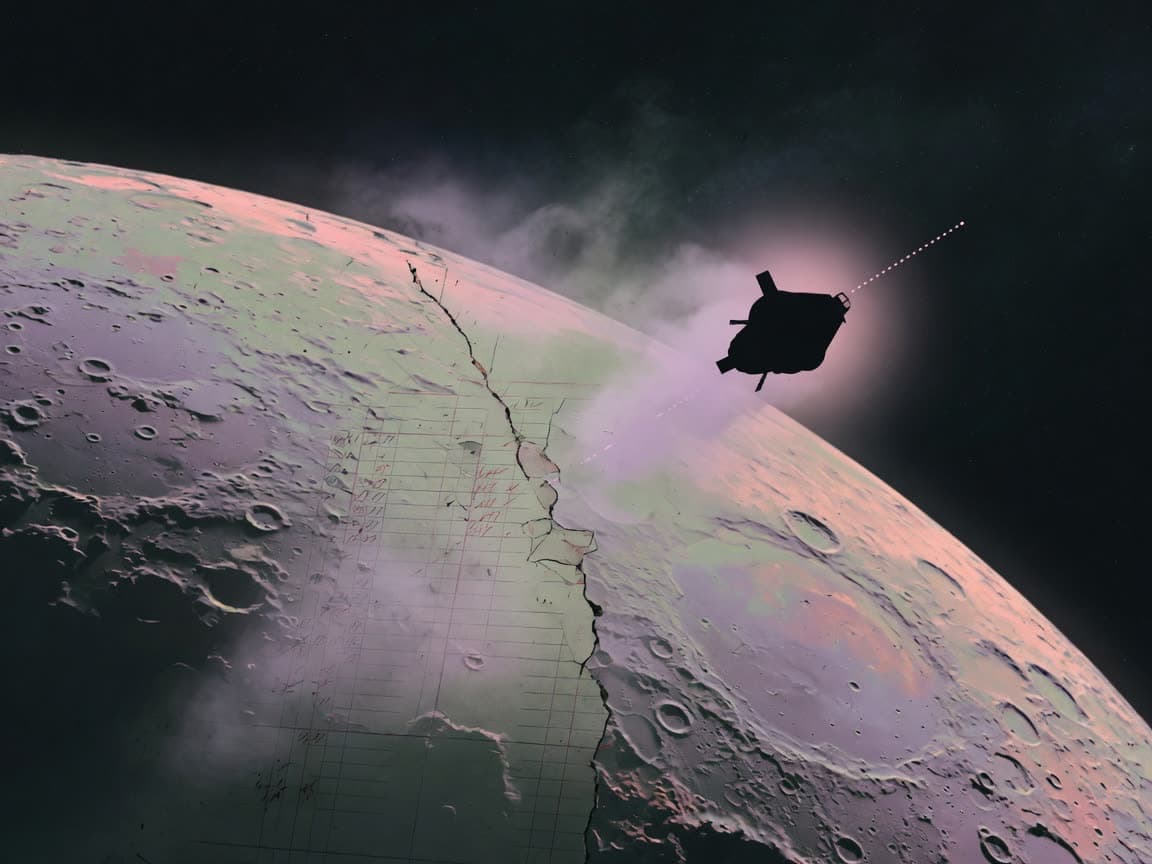
On April 6, 2026, four astronauts crossed into the Moon's sphere of influence — the first crew to make that approach since Apollo 17 left the surface in December 1972. Artemis II had lifted off five days earlier from Pad 39-B, the rocket that took fifteen years and well past $100 billion to build finally doing the one thing it was built to do. It was, by any honest measure, NASA's greatest moment in half a century.
The following day, the White House proposed cutting the agency's budget by roughly 25%.
That is not a coincidence of timing; it is the policy. The FY2027 request would drop NASA's topline from $24.4 billion to $18.8 billion, with the heaviest blows landing on science — sliced from $7.3 billion to $3.9 billion — and on the orbiting infrastructure that keeps the agency in low Earth orbit at all. More than 40 missions deemed "lower priority" would be killed outright, Mars Sample Return among them. The budget document calls the Space Launch System, the very rocket that just succeeded, "grossly expensive and delayed," and proposes retiring SLS, Orion, and Gateway after Artemis III. The hardware that reached the Moon is being decommissioned in the same breath it's being celebrated.
The handoff is the headline
Read past the topline and a coherent thesis emerges, even if you hate it. Exploration funding actually rises — from $7.8 billion to $8.5 billion — with a fresh $1 billion earmarked to begin staging crewed Mars missions. Washington isn't abandoning deep space; it's trying to fire the in-house rocket program and replace it with a procurement model. SpaceX has the lander contract for Artemis III and IV, Blue Origin for Artemis V, and the long-term bet is that Starship and Blue Moon make a government-owned heavy lifter look like a museum piece. In February, NASA quietly cancelled the SLS Block 1B and Block 2 upgrades and froze the design at Block 1 — the procurement equivalent of refusing to renovate a house you intend to sell.
The trouble is the replacements aren't ready. SpaceX's Starship lander is running, by NASA's own Inspector General, at least two years behind — and on April 3, Elon Musk pushed the next test flight another four to six weeks out. You cannot retire the bridge before the new one is load-bearing, and that is precisely the gap this budget bets the program on. Congress noticed: the same cohort that handed NASA only minor cuts last cycle, on bipartisan pushback, is unlikely to swallow a quarter-fold reduction now. This request is an opening offer, not a settled fact.
Where the machines come in
The quieter, more durable story is what's filling the vacuum below the headline missions: autonomy. NASA's 2026 Lunabotics field grew from 12 fully autonomous robots last year to 27 — student-built machines that shape regolith into protective berms, the unglamorous groundwork of any permanent outpost. The Infrastructure Pilot Excavator, IPEx, is being readied to dig and haul lunar soil with minimal human input. The agency is folding AI into spacesuit-damage detection, habitat management, and distributed spacecraft control. This is the same current running through the rest of 2026's tech economy — agents moving from talk to action, humanoid robots leaving the demo stage — except the labor shortage here is structural. There are no humans on the Moon to do the digging, and a budget this lean can't afford to send many. Autonomy isn't a feature on the lunar surface; it's the only affordable workforce.
The deeper irony is compute. The Mars and lunar autonomy NASA is now leaning on rides on the same Nvidia-class hardware powering every AI lab on Earth — and a $3.9 billion science budget buys a lot less of it than the private sector commands. Washington wants the outcomes of the AI-robotics boom without funding its inputs, and is hoping commercial partners absorb the difference. Sometimes that works. Sometimes you get a lander two years late and a flight schedule that slips by the month. The Moon is back within reach for the first time in fifty years; whether the government that got there can still afford the bill is the question the next twelve months of appropriations will answer.
Sources: CNN, The Register, SpaceNews, NBC News, NASA Artemis III, NASA Lunabotics 2026.