
Nvidia's Next Bottleneck Isn't the Chip — It's the Light
Spectrum-X Photonics moves the optics onto the switch ASIC itself, trading copper for co-packaged light. It's the unglamorous move that decides whether AI factories can scale to a million GPUs.
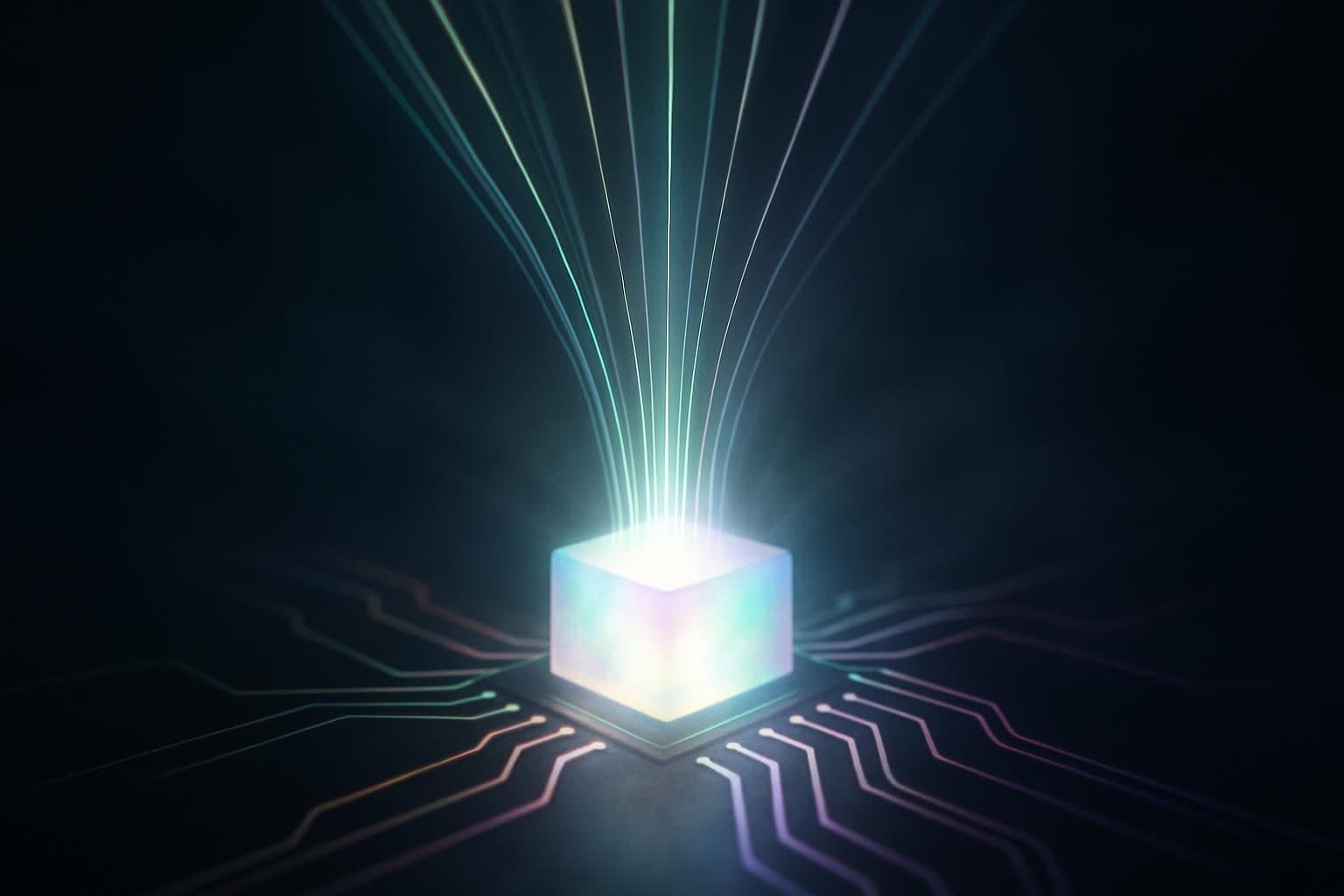
The story everyone tells about Nvidia is a story about chips — faster GPUs, more transistors, another generation of Blackwell or Rubin silicon that resets the performance curve. But the most consequential thing Nvidia is shipping into AI data centers this year may not be a chip at all. It's a way of moving data with light, and it targets a problem that no amount of GPU horsepower can fix on its own: the wires between the GPUs.
That problem has a name in the industry — the interconnect wall. As AI clusters swell from thousands of accelerators toward hundreds of thousands and beyond, the limiting factor stops being how fast each GPU computes and becomes how fast you can shuttle data between them without melting the power budget. Every model spread across many GPUs spends enormous time and energy just synchronizing. Past a certain scale, copper and conventional pluggable optics can't keep up — the electrical signaling that's carried the industry for decades starts to buckle under the bandwidth and power demands of frontier training.
What co-packaged optics actually changes
Nvidia's answer is Spectrum-X Photonics (and its InfiniBand sibling, Quantum-X), a generation of networking switches built around co-packaged optics (CPO). The phrase is dry; the idea is not. Traditionally, a switch is an electrical chip, and converting its signals to light for long-distance transport happens in separate, pluggable optical modules bolted on around it. Each conversion costs power and introduces a point of failure, and you need a lot of them. CPO collapses that: it integrates the optical engines directly onto the switch ASIC's package, so light is generated and received right next to the silicon instead of across the board.
The payoff Nvidia claims is the kind that only matters at scale. By bringing optics on-package, Spectrum-X Photonics uses 4x fewer lasers while delivering roughly 3.5x more power efficiency, 63x greater signal integrity, and 10x better network resiliency than traditional designs — and it cuts deployment time meaningfully. The flagship Ethernet variant pushes up to 409.6 terabits per second of bandwidth per switch. Those numbers are aimed squarely at one goal Nvidia keeps repeating: connecting millions of GPUs across an AI factory — and across multiple sites — as if they were one machine.
Why lasers became the constraint
To see why this is a frontier problem rather than a networking footnote, follow the power. Cooling already consumes something like 40% of a large data center's electricity. Optical interconnect is the next line item climbing the same curve: at million-GPU scale, the sheer number of lasers and the energy lost in electrical-to-optical conversions becomes a tax on the entire facility. Lasers are also among the least reliable components in the optical chain, so multiplying them across a giant cluster multiplies your failure surface. Cutting laser count fourfold isn't a spec-sheet flex — it's removing thousands of things that can break and thousands of watts that do nothing but convert signals.
This is the part of AI infrastructure that doesn't demo well and decides everything. A model announcement gets the headline; whether you can physically wire enough accelerators together, powered and reliable, to train the next one is the quiet question underneath. Nvidia is betting that the company that owns the interconnect — not just the compute — owns the scaling roadmap, because the interconnect is what determines how big a single coherent system can get.
The manufacturing moat under the moat
The reason this is hard to copy lives in how it's built. Co-packaged optics demands marrying photonics and cutting-edge logic at the package level, and Nvidia is doing it with TSMC's silicon-photonics process combined with TSMC's SoIC 3D chip-stacking. That pairing — advanced-node logic and integrated optics fused in one package by the world's leading foundry — is exactly the kind of supply-chain choreography that competitors can describe far more easily than they can reproduce.
It also reframes the competitive map. Broadcom, the other heavyweight in the co-packaged-optics race, is pursuing its own approach to the same physics, and the contest between the two is becoming one of the defining infrastructure battles of the AI buildout. The interesting wrinkle is that this is a fight over a layer most people never think about — the switch that sits between the GPUs — yet it may shape which clusters can scale and which hit a wall sooner than their owners expect. Spectrum-X Ethernet Photonics is slated for availability in the second half of 2026, putting the technology into real AI factories on the same timeline as Nvidia's Vera Rubin compute ramp.
The pattern, again
There's a familiar Nvidia move underneath all of this. The company keeps winning not by selling the single fastest part but by co-designing the whole system — compute, memory, interconnect, software — so that the cheapest, most scalable path to building an AI factory routes through Nvidia by default. Photonics is the newest expression of that strategy: by absorbing the optical interconnect into its own platform, Nvidia ensures that the answer to "how do I scale past a million GPUs?" increasingly has its name on it.
So while the next headline will be about a faster GPU, watch the switch instead. The transistor is no longer the only thing standing between a lab and a bigger model. Increasingly it's the photon — and Nvidia just moved the photon onto the package. The bottleneck shifted from silicon to light, which means the company that learns to bend the light fastest gets to decide how large the next generation of AI gets to be.