
Quantinuum Braided Exotic Particles Into a Universal Gate Set
A Nature paper shows a complete, fault-tolerant set of quantum gates built by braiding and fusing non-Abelian anyons — a route that sidesteps the single most expensive tax in quantum computing.
Quantum computing's central problem was never speed. It was reliability — and for years the field's answer to reliability came with a bill so large it threatened to eat the whole machine. A paper published in Nature on July 15 describes an experiment that, if it scales, doesn't pay that bill. It refuses it.
Quantinuum, working with the University of Chicago's Pritzker School of Molecular Engineering, Harvard, and Stony Brook, demonstrated the first universal topological gate set built from non-Abelian anyons on real hardware. The result runs on Quantinuum's H2 trapped-ion processor, entangling 54 physical qubits into a stable topological state organized by the S3 non-Abelian symmetry group. In plainer terms: the team stored quantum information not in individual, fragile qubits but in the collective, tangled relationships between exotic emergent particles — and then computed with it.
Why fragility is the whole story
A physical qubit is a coward. Left alone, it decoheres — a stray photon, a thermal jitter, a whisper of electromagnetic noise flips its state and the computation dissolves. The standard defense is quantum error correction: spread one reliable "logical" qubit across many noisy physical ones, and use the redundancy to detect and repair errors faster than they accumulate. It works. It is also brutally expensive, and one operation in particular is the villain.
Universal quantum computing requires a specific hard gate — a non-Clifford operation, usually a T-gate — that error correction cannot produce cheaply. The workaround, magic-state distillation, manufactures the special quantum states that gate needs by consuming huge numbers of lower-quality states and filtering them down to a few pure ones. Estimates routinely put distillation at the majority of the physical qubits and runtime in a fault-tolerant machine. It is the reason "a useful quantum computer needs millions of qubits" became a common refrain. Most of those millions weren't computing. They were purifying.
Braiding as computation
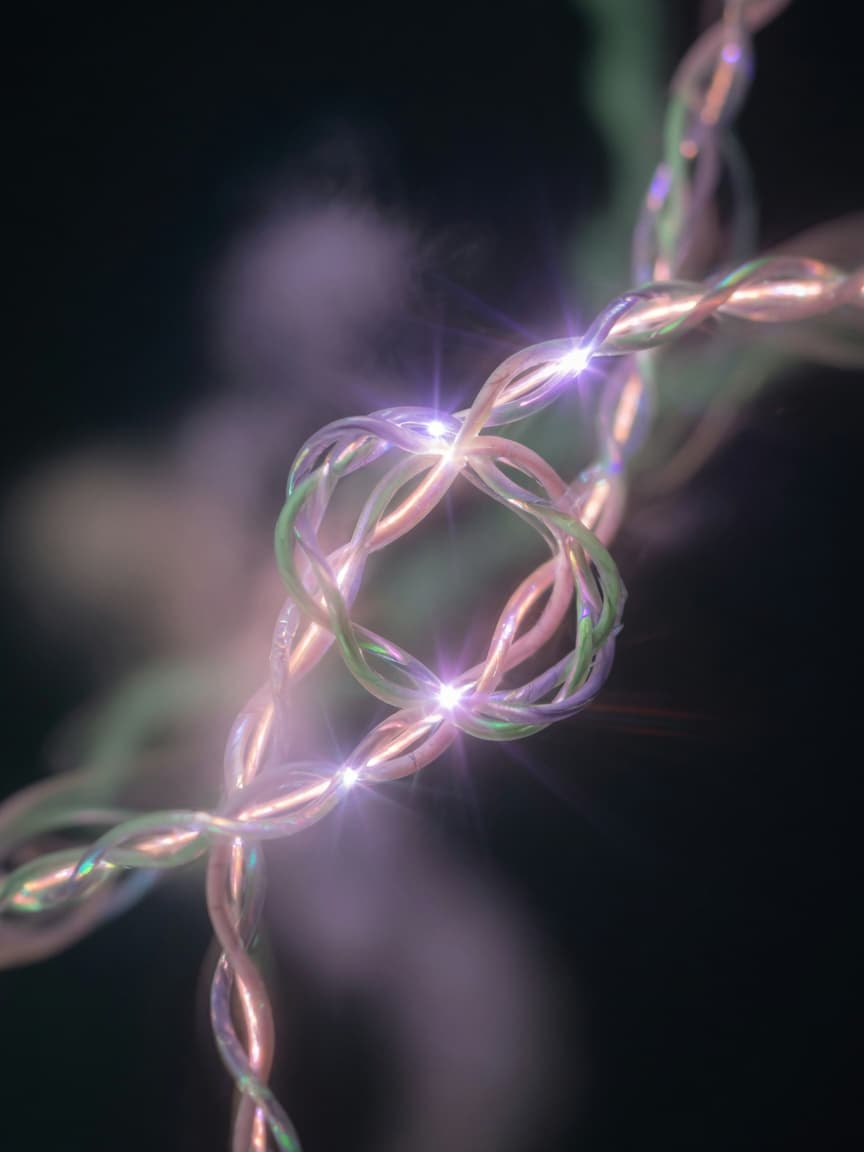
Topological quantum computing was proposed decades ago precisely to dodge this. The idea: encode information in a property of the system that is topological — a feature of how things are woven together, not where any single particle sits. Braid two non-Abelian anyons around each other and the system's state changes in a way that depends only on the pattern of the braid, not on the exact path taken. Nudge a particle, jitter it, expose it to noise — as long as you don't undo the braid, the encoded information survives. Robustness stops being something you bolt on with error correction and becomes a property of the physics itself.
The catch, for twenty-odd years, was that non-Abelian anyons were mostly theoretical, and braiding alone doesn't give you every gate you need. Quantinuum's result closes both gaps at once. The team created and manipulated the anyons on hardware, then combined braiding with a second primitive — fusion, a measurement that reads out how anyons combine — to assemble a complete toolkit of operations. Complete is the load-bearing word. A universal gate set can, in principle, run any quantum algorithm.
The payoff is the part that should get an engineer's attention: this route reaches universality without magic-state distillation. The hard non-Clifford gate that forced the field to build purification factories is delivered instead by the fusion structure of the anyons. If distillation was the majority of the overhead in a fault-tolerant design, removing it doesn't shave the cost. It changes the slope of the entire scaling curve.
What this is, and what it isn't
Restraint is warranted. This is a 54-qubit demonstration on a trapped-ion system, engineered to prove a principle, not a commercial processor solving a commercial problem. The topological state is a carefully prepared laboratory object; scaling it to the qubit counts real workloads demand is a separate, unfinished problem, and trapped-ion machines have their own throughput constraints. Nobody factored a number or simulated a drug here. What happened is narrower and, in the long arc, more important: a mechanism that existed only in theory now exists on a chip.
The strategic read is that the field just acquired a second credible path to fault tolerance. The dominant program — surface codes plus magic-state distillation on superconducting hardware — is a known quantity with a known, punishing overhead. The topological program was the elegant alternative that never quite touched hardware. Now it has, with a universal gate set attached. Two roads to the same destination, with very different cost structures, is exactly the kind of optionality a young industry wants before it commits tens of billions to one architecture.
The number that matters later
For a decade the working assumption has been that useful quantum computing means an eye-watering ratio of physical to logical qubits, most of that ratio spent on error correction and distillation. That assumption priced the timelines, sized the data centers, and shaped where the money went. A route to universality that skips distillation attacks the largest single term in that equation.
It is early. The braid demonstrated in a lab is a long way from a machine that breaks encryption or designs a catalyst. But the history of quantum computing is a history of overhead — of the gap between what the physics promises and what the error budget allows. Quantinuum's anyons don't close that gap. They redraw where it sits. And on a problem defined almost entirely by its cost of reliability, redrawing the cost is the breakthrough.