
Low Orbit Is the New Land Grab
Starlink already owns most of the sky. Amazon's Kuiper is finally launching, direct-to-cell is rewiring the phone in your pocket, and the economics of putting thousands of satellites overhead have become a geopolitical contest no government fully controls.
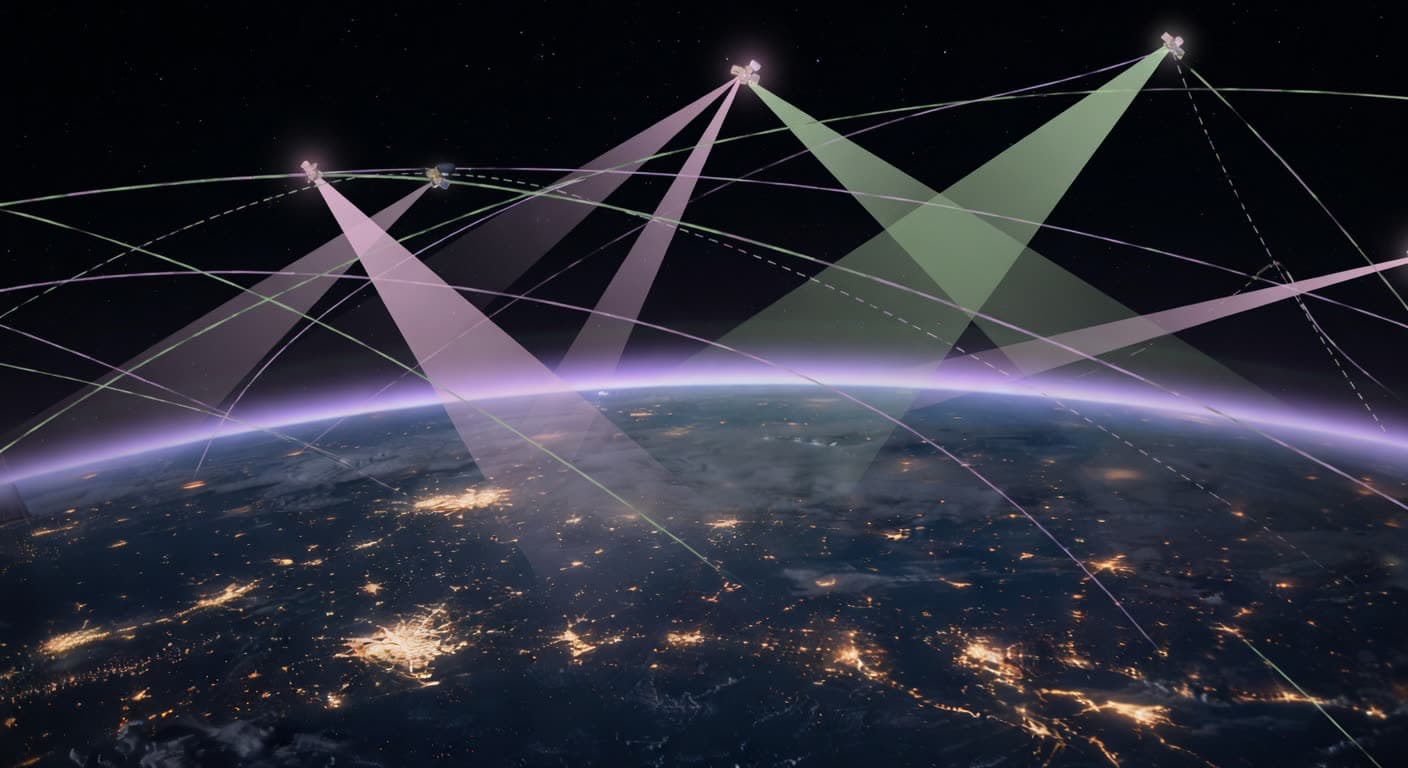
There are now more than 7,000 Starlink satellites in low Earth orbit, and the constellation serves well over six million subscribers across more than a hundred countries. No competitor is close. That lead — built launch by launch while everyone else was still writing slide decks — is the single most important fact in the satellite-internet land grab, because in low orbit, the first mover doesn't just win customers. It wins spectrum, orbital slots, regulatory precedent, and the launch cadence that makes all three self-reinforcing. The race for the sky is no longer about whether LEO broadband works. It's about who's allowed to own it.
The cadence moat
Starlink's real advantage isn't the dish on the roof. It's the rocket under the satellites. SpaceX flies Falcon 9 at a tempo no one has matched, and it launches its own constellation as the anchor tenant of its own launch business — a vertical integration so complete that the marginal cost of adding satellites approaches the cost of building them. Starship, when it scales, multiplies that advantage by an order of magnitude, lofting far larger payloads per flight.
That cadence is the moat. A LEO satellite has a working life of roughly five years before atmospheric drag pulls it down, which means a constellation isn't a thing you build once — it's a thing you must continuously replace forever. Anyone who wants to compete has to launch thousands of satellites and then keep launching thousands of satellites, indefinitely, just to stand still. Without cheap, frequent, reusable access to orbit, the math never closes.
A satellite constellation is not infrastructure you finish. It is a treadmill you can never step off, and SpaceX owns the only fast treadmill.
Kuiper finally leaves the ground
Amazon's Project Kuiper spent years as the constellation that existed mostly on paper. That changed in 2025, when it began launching operational satellites in earnest — racing against an FCC license requirement to deploy roughly half of its planned 3,200-plus satellites by mid-2026, a deadline it has been straining to meet partly by buying launches from rivals, including, awkwardly, SpaceX itself.
Kuiper's bet is the rest of Amazon: AWS for ground-station and backhaul integration, Amazon's retail and logistics muscle to manufacture and distribute terminals at scale, and Prime's distribution reach to put the service in front of consumers. The thesis is that connectivity becomes another Amazon utility, bundled and undercut on price the way the company has done to so many categories before. The risk is equally clear — Amazon is years and thousands of satellites behind, lacks its own high-cadence heavy launch vehicle, and is trying to catch a competitor that gets faster every quarter.
Direct-to-cell rewrites the phone
The most consequential shift isn't the dish at all — it's the phone already in your pocket. Direct-to-cell satellite service, which lets an ordinary unmodified smartphone connect to a satellite when no tower is in range, moved from demo to commercial reality. SpaceX, partnered with T-Mobile in the U.S., began offering text and basic data from space, with voice and broader data on the roadmap. AST SpaceMobile is pursuing the same prize with enormous phased-array satellites and carrier partners including AT&T and Verizon, betting on bandwidth per satellite rather than sheer constellation count.
This is a categorically bigger market than rooftop dishes. The dish business addresses people who lack fixed broadband — meaningful, but bounded. Direct-to-cell addresses everyone with a phone, anywhere the network thins out: the dead zone on the highway, the boat offshore, the hiking trail, the disaster zone where the towers went down. It turns "no signal" from a permanent condition into a temporary one, and it makes the satellite operator a silent partner to every mobile carrier on Earth.
The dish was a niche. The phone is the planet. Whoever owns the link from the open sky to an ordinary handset owns a layer beneath every telecom on Earth.
The economics and the politics collide
Here is where the land grab stops being a business story and becomes a geopolitical one. Spectrum and orbital slots are finite and governed by the ITU on a first-come, first-served logic that rewards exactly the kind of aggressive early deployment SpaceX has executed. Every slot Starlink fills is a slot no one else can. Astronomers warn about light pollution and the radio noise from thousands of transmitters; orbital-debris specialists warn that a crowded, multi-operator LEO raises collision risk for everyone — a Kessler-cascade tail risk that no single company is incentivized to price in.
And the strategic dimension is now undeniable. Starlink's role in Ukraine made it a battlefield utility — and made the world acutely aware that a single private company, answerable to one founder, controls connectivity that nations depend on. That realization is driving sovereign responses: the EU's IRIS² constellation, China's Guowang and the Shanghai-backed Qianfan ("Thousand Sails") megaconstellations, each explicitly framed as strategic infrastructure rather than a consumer product. Beijing has filed for tens of thousands of satellites. The sky is being partitioned by states that have concluded LEO is too important to rent from an American billionaire.
The economics favor consolidation — the cadence moat is real, and most challengers will fail or merge. The politics favor fragmentation — no major power wants to depend on a constellation it can't control. Those two forces are now colliding directly over our heads, and the resolution will shape who can speak to whom, and who can be cut off, for the next generation.
Kicker: The terrestrial internet was built on cables governments could regulate and route around. The orbital internet is being claimed in real time by whoever launches fastest — and right now, that's one company, watched nervously by every nation that just realized it should have started sooner.