
The Sky Learned to Think Before It Sends
Earth observation's 2026 inflection is not sharper pixels — it's satellites that decide what matters in orbit and beam down answers, not images.
On May 3, EarthDaily Analytics put six satellites into orbit on a single Falcon 9 rideshare and announced, with the kind of restraint that means the opposite, that "this is not a routine launch update." Three weeks later the U.S. National Reconnaissance Office handed the company a contract — modest at $1.2 million, but the NRO's checks are never really about the money. They're about which commercial vendors get to feed the intelligence machine. The constellation EarthDaily is building reads Earth across 22 spectral bands, every day, at a scale meant to be chewed on by models rather than admired by analysts. Note the phrasing that recurs across every press release this spring: "AI-ready." Not high-resolution. Not high-revisit. AI-ready.
That word is the whole story. For two decades the Earth observation race was a contest over the picture — finer pixels, faster revisit, more bands. The race in 2026 is over the decision, and increasingly that decision is being made before the data ever touches the ground.
The compute moved upstairs
Satellogic spelled it out most bluntly. In March the company introduced Merlin, a constellation designed to remap the entire planet daily at one-meter resolution — a combination it argues simply doesn't exist on orbit today. The first satellite launches in October, full operational capability in the first half of 2027. The headline number is the one meter. The actual product is buried in the spec sheet: "AI-driven onboard processing capable of analysing every pixel for classification and object detection," paired with inter-satellite links for real-time alerting. Merlin is "defense-first," fully funded by a single $30 million customer contract, and built to skip the part where humans look at photographs.
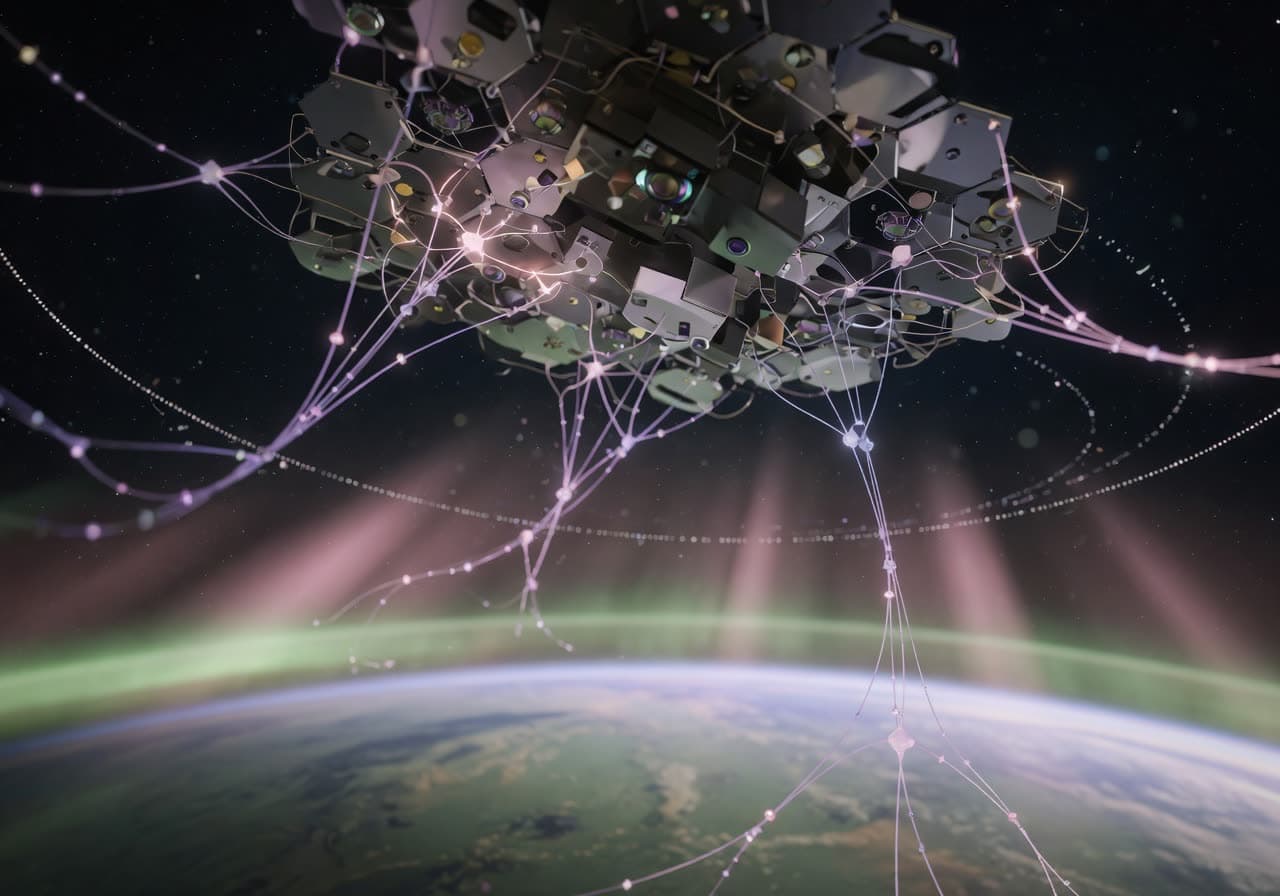
This is the inversion that matters. A traditional imaging satellite is a camera with a radio — it captures, compresses, and waits for a ground pass to dump raw pixels into a pipeline where, eventually, software or a person finds the ship, the wildfire, the troop movement. Onboard inference collapses that loop. The satellite runs the model in orbit, decides a 30-megabyte scene contains nothing but ocean, and discards it. It finds the anomaly and downlinks a thirty-byte alert instead of a thirty-gigabyte file. Bandwidth, the eternal chokepoint of space, stops being the binding constraint. The constraint becomes: how good is the model you flew?
NASA is institutionalizing exactly this. Its "Space to Soil" challenge, opened in late January, asks the smallsat community to build missions around adaptive sensing and onboard AI for monitoring agriculture and forests. The agency that historically wanted every photon archived is now explicitly funding satellites that throw data away intelligently. When the conservative end of the field starts optimizing for discernment over collection, the paradigm has already shifted underneath you.
Edge computing, but the edge is 500 kilometers up
It's worth naming what this actually is, because the space industry dresses it in its own vocabulary. This is the agentic turn arriving in orbit. The same migration reshaping everything terrestrial in 2026 — models moving from chatbots that talk to systems that act, inference pushed to the edge where the data lives, autonomy replacing the round-trip to a human — is now playing out 500 kilometers overhead. A Merlin satellite tasking itself, scoring its own imagery, and dispatching an alert without a ground station in the loop is an edge agent. It just happens to be travelling at seven kilometers a second.
And it all runs on the same compute supremacy bending every other curve. The radiation-hardened inference chips going into these spacecraft trace their lineage to the GPU architectures Nvidia sells by the data-center. The models trained to find a fishing trawler in a hyperspectral cube are downstream of the same arms race producing generative video and humanoid-robot demos. Earth observation has quietly become one of the most demanding edge-AI deployments anywhere — adversarial conditions, no maintenance window, latency measured against a fast-moving planet. India's Pixxel, now flying its five-meter Firefly hyperspectral fleet with a separate NRO data contract of its own, is betting the same way: roughly 450 spectral bands are useless to a human eye and indispensable to a model trained to read crop disease, methane plumes, and mineralogy off the spectrum.
Here is the tension I'd watch. When the satellite decides what's worth your attention, the model becomes the sovereign. We are wiring national-security and climate-critical observation to onboard systems whose training data, failure modes, and biases ship sealed inside a spacecraft that cannot be patched on a whim. An imaging satellite that returned bad pixels gave you a bad picture you could at least inspect. An inference satellite that returns a bad judgment gives you confident silence — the anomaly it was trained not to see, the alert it never sent. The NRO contracts, the defense-first constellations, the "AI-ready" insistence all point the same direction: we are choosing to trust the orbital model's discernment because the bandwidth math leaves no alternative.
The pixels were never the point. They were the cost of not yet being able to think up there. In 2026, the sky learned to think first and speak second — and the only real question left is whether we can audit what it chose not to say.