
Moon Ice, Dead Orbiters, and the Telescope That Could Rewrite Cosmology
Three major space science stories are converging in June 2026 — and together they sketch the most consequential stretch of planetary science in a generation.
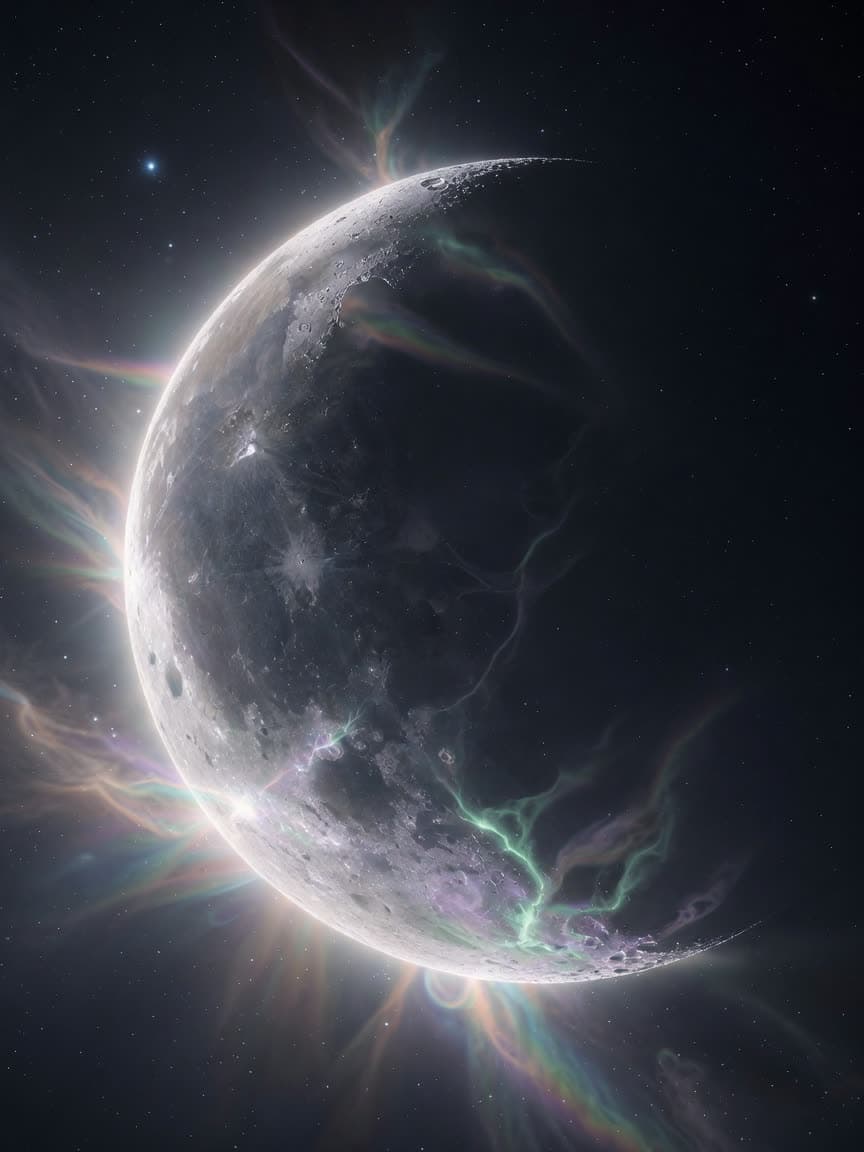
The first week of June 2026 handed planetary scientists more to process than most years deliver in full. NASA declared a $582 million Mars orbiter dead. Chandrayaan-2 radar data confirmed what lunar geologists have theorized for decades: water ice, thick and accessible, buried beneath the Moon's south polar craters. And the Nancy Grace Roman Space Telescope — NASA's most powerful wide-field infrared observatory — locked in an August 30 launch date that could reshape our understanding of dark energy and the structure of the universe. Each story is significant on its own. Together, they mark something like an inflection point.
MAVEN Is Gone, and Mars Science Feels the Loss
MAVEN didn't fail. It was stolen — by a mystery that may never be solved.
On December 6, 2025, the Mars Atmosphere and Volatile Evolution orbiter passed behind the red planet for a routine 20-to-30-minute blackout. When it re-emerged on the other side, something was wrong. A fragment of telemetry captured by NASA's Deep Space Network open-loop receivers showed the spacecraft spinning at an abnormal rate, deep in safe mode. Every subsequent contact attempt over the following six months returned silence.
On June 3, NASA made it official: MAVEN is dead. Eleven-plus years in Mars orbit, more than a decade of atmosphere data, and the most comprehensive picture ever assembled of how Mars lost its oceans and magnetic field — all ended with a single unexplained anomaly. The spacecraft's last major finding, published in early 2025, traced the mechanism by which solar wind strips Martian atmosphere at a rate of roughly 100 grams per second during solar storms. That number is now foundational to every Mars habitability model in circulation.
The loss is operational as well as scientific. MAVEN served double duty as a communications relay for surface rovers. NASA has coverage from other orbiters, but redundancy in the Mars relay constellation just got thinner at precisely the moment the next Mars launch window — late 2026 — is approaching.
The Moon Has Water. Now We Know Where to Dig.
Meanwhile, the Moon's south pole went from "promising" to "confirmed" in the span of a week.
Researchers combing through radar data from India's Chandrayaan-2 orbiter published findings in late May showing strong evidence of subsurface water ice beneath permanently shadowed craters in the lunar south polar region. The clearest signal came from a 1.1-kilometer-wide unnamed crater inside the larger Faustini basin — a region so cold that volatiles deposited over billions of years have never sublimated. The ice isn't exposed surface frost. It sits beneath a layer of regolith, which means any extraction mission will need to drill or excavate. But the depths implied by the radar returns are manageable: early estimates put the ice layer within reach of near-term ISRU (in-situ resource utilization) hardware.
This changes the arithmetic of lunar permanence. Water ice at the south pole means fuel, oxygen, and radiation shielding can potentially be sourced on-site rather than hauled from Earth at roughly $2,000 per kilogram under current Falcon Heavy economics. China's Chang'e-7 mission, slated to explore the same region, now carries even higher strategic stakes — Beijing framed it explicitly as an ice-scouting mission in its March mission brief. The commercial calculus is already shifting: multiple lunar mining startups have begun presenting south-pole resource maps in investor decks that cite the Chandrayaan-2 findings as their scientific foundation.
NASA's own water-hunting instrument, deployed via a March 2026 commercial lander, was designed to triangulate exactly these deposits from the surface. The agency is now sitting on two converging data streams — orbital radar and surface spectroscopy — that, when combined, could yield the first actionable ice maps ahead of the Griffin Mission One landing attempt later this year.
Artemis Is Still Moving, Slower Than Advertised
The crew announcement for Artemis III is scheduled for June 9 at Johnson Space Center — a rare piece of good news optics for a program that has spent the better part of 2026 absorbing schedule revisions.
The mission profile itself has shifted significantly from the original plan. Artemis III, now targeting late 2027, will no longer attempt a lunar landing. Under the revised architecture, four astronauts will launch aboard the Space Launch System and rendezvous in low Earth orbit with SpaceX's Starship HLS and Blue Origin's Blue Moon lander — testing docking procedures and evaluating the Axiom AxEMU spacesuit in a zero-g environment without touching down. The actual south pole landing gets pushed to Artemis IV, currently penciled for late 2028.
Critics inside the planetary science community are fraying at the edges over the pace. But the revised plan does something the original didn't: it puts both commercially developed landers through a real hardware handshake in space before committing astronauts to descent. Given what happened to MAVEN — a spacecraft that performed flawlessly for a decade before a single unexplained anomaly ended the mission — that caution is not entirely misplaced.
Roman Is Ready, and the Universe Has No Idea What's Coming
The biggest telescope story of the year has been building quietly. The Nancy Grace Roman Space Telescope completed construction in November 2025 after years of budget fights, pandemic delays, and a congressional near-death experience. As of this week, it has a confirmed launch date: August 30, 2026, aboard a Falcon Heavy to the Sun-Earth L2 point, four times farther out than the Moon.
Roman's footprint is its distinguishing feature. Where James Webb points a narrow beam and stares deep, Roman throws open a field of view roughly 100 times larger than Webb's and sweeps the sky systematically. Its infrared camera will produce a survey of the cosmos at a scale that has no precedent — the equivalent of mapping the entire continental United States down to the scale of individual city blocks, every few months, for five years.
The scientific targets are cosmology's hardest open questions: the distribution of dark matter, the equation-of-state of dark energy, and the population of rogue planets wandering between stars unattached to any solar system. One of Roman's core programs will conduct a microlensing survey of the galactic bulge sensitive enough to detect Earth-mass rogue planets — objects that have never been systematically catalogued. Early estimates from the mission team suggest Roman could detect thousands of them.
Roman arrives at L2 while Webb is still operating. The two observatories will work in tandem: Roman finds targets at scale, Webb stares at the interesting ones. It's the most complementary pair of space telescopes since Hubble and Spitzer overlapped. The first science data is expected within six months of deployment.
The Shape of What's Coming
Three stories, one throughline: the solar system is becoming legible at a resolution that would have been science fiction a decade ago. Ice at the lunar south pole goes from theory to mapped deposit. Mars gives up its atmospheric secrets through a probe that ran for 11 years, then vanishes before we could ask it a follow-up question. And a new observatory, carrying the most ambitious survey program ever flown, is three months from launch.
The compression is striking. Planetary science has historically moved in 10-year cycles gated by mission cadence and launch windows. What's happening in June 2026 suggests the cadence is tightening — partly because launch costs have dropped enough to field more missions in parallel, partly because AI-assisted data reduction is letting scientists process years of backlogged observations in weeks. The pile of unanswered questions isn't shrinking. But the rate at which we're generating answers is accelerating faster than almost anyone predicted.
MAVEN's silence is a reminder that the hardware is still fragile, the distances still enormous, and the margin for error still razor thin. The Roman telescope, gleaming in a clean room and three months from the pad, is the counterpoint: the audacity to build an instrument that can see the whole cosmos at once and ask it everything simultaneously.
That's where we are. The universe is talking. We're finally building ears big enough to hear it.