
The Year Starship Has to Land Itself
SpaceX's biggest rocket is past the proof-of-concept era and into the part that actually matters: catching boosters, refurbishing ships, and turning a sci-fi cost curve into a launch-market fact.
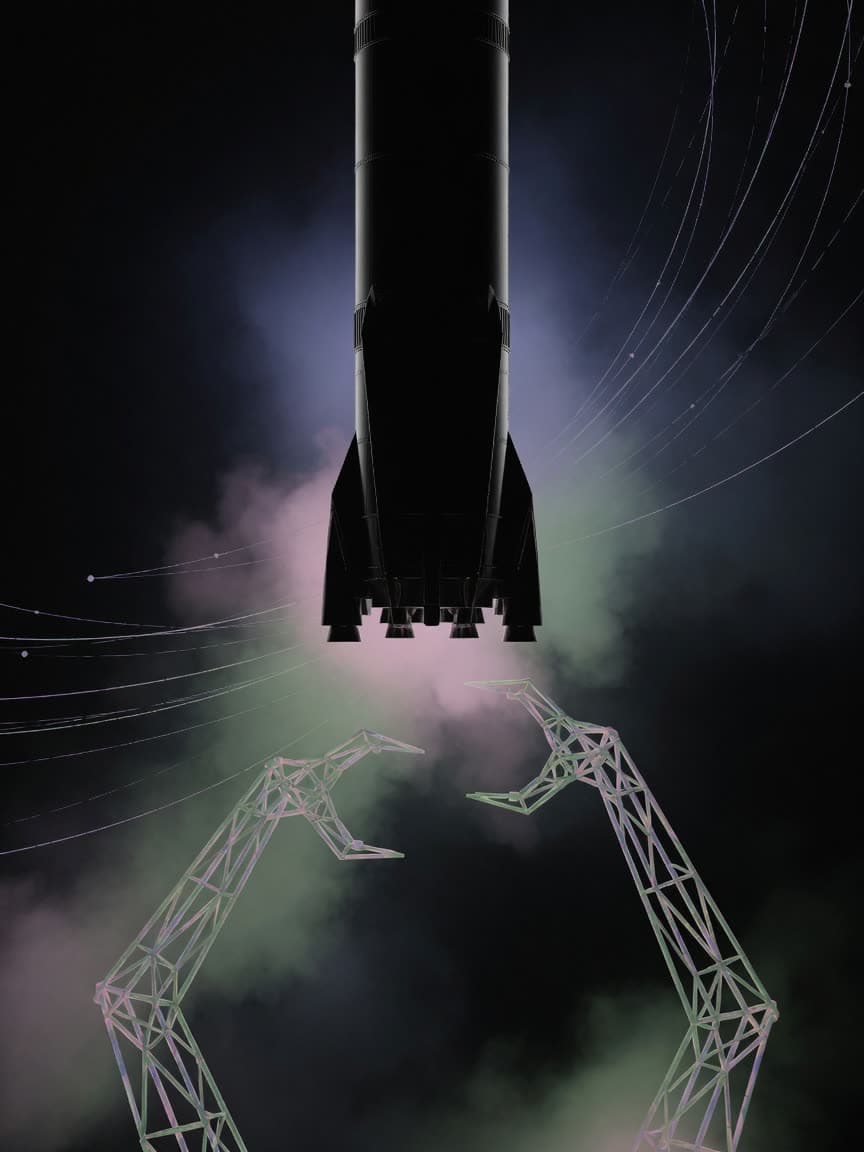
There is a specific sound engineers at Starbase listen for now, and it is not the roar of thirty-three Raptors lighting in sequence. It is the metallic clang, a few minutes later, of a returning booster settling into the chopsticks of the launch tower. By mid-2026, that catch has happened enough times to stop being a miracle and start being a metric — and that shift, from spectacle to statistic, is the whole story of where Starship stands this year.
The program has moved past the question that dominated 2023 and 2024 — can this thing reach orbit and come back — and into the harder, less cinematic one that defines every reusable vehicle in history: can you fly the same hardware again, soon, cheaply, and without a heroic refurbishment campaign between every flight? That is the test SpaceX is running right now, in public, with the whole launch industry watching its margins.
From "does it work" to "how fast can it turn"
The early Starship campaign was a fireworks show with telemetry. Vehicles cleared the pad, staged, and then — repeatedly — disassembled themselves over the Gulf or the Indian Ocean in ways that nonetheless taught SpaceX exactly what it needed. That iterative, hardware-rich approach drew predictable criticism for its failure rate, and just as predictably, it worked: each loss bought data that a more conservative program would have spent years simulating.
What's different in 2026 is the nature of the setbacks. They're no longer existential; they're operational. A booster catch that aborts to a soft water landing. An upper-stage ("Ship") that survives reentry but comes back with tiles missing and structural questions attached. A static fire that flags a Raptor turbopump issue and slips a launch by three weeks. These are the problems of a program trying to operationalize reuse, not prove it's possible — and they are exactly the problems that separate a working rocket from an economically transformative one.
The booster was always the easier half. The Ship is where the real money — and the real heat — lives. Catching Super Heavy is a controllability problem SpaceX largely understands, an extension of the Falcon 9 landing it has executed hundreds of times. Bringing the upper stage back from orbital velocity, through the brutal thermal environment of reentry, with a heat shield that can be inspected and reflown rather than rebuilt — that is the unsolved frontier. The tile system has been the program's most stubborn engineering saga, and how cleanly the Ship comes home is the single clearest signal of whether full reusability is months or years away.
The cost curve underneath everything
Strip away the Mars rhetoric and Starship is, at its core, an argument about marginal cost. Falcon 9 already rewrote launch economics by reusing first stages; Starship's bet is that reusing both stages, at far greater scale, collapses cost-to-orbit by another order of magnitude.
The headline numbers SpaceX has floated — payload to orbit measured in the low single-digit dollars per kilogram at full cadence — should be read as a destination, not a current invoice. Today's real per-flight cost is dominated by a Ship that doesn't yet reliably refly and a cadence still measured in weeks, not days. But the direction is what reorders the industry. Even a Starship that lands at ten or twenty times Falcon 9's payload for a comparable marginal cost changes the fundamental unit of space planning from "how much can we afford to launch" to "what would we build if mass were nearly free."
That inversion is the part competitors find hardest to price against. You cannot incrementally optimize your way to a 10x cost advantage; you have to architect for it from the engines up.
What cheap mass actually unlocks
Three concrete programs turn that abstract cost curve into hardware on orbit.
Starlink v3. This is the nearest-term, least-glamorous, and arguably most important payoff. The next-generation Starlink satellites are too large and too heavy to fly efficiently on Falcon 9 — they're designed around Starship's bay. A working Starship lets SpaceX deploy dramatically more downlink capacity per launch, and Starlink's revenue is what underwrites the entire enterprise. In a real sense, Starship's most demanding early customer is SpaceX itself, and v3 is the flywheel: launches fund satellites, satellites fund launches.
Artemis and the lunar lander. NASA's plan to return crew to the Moon hinges on a Starship variant serving as the Human Landing System. That architecture carries a dependency most casual observers underestimate: it requires propellant transfer in orbit — multiple tanker flights to refuel a single lunar Ship. Demonstrating cryogenic transfer at scale is a gating milestone not just for Artemis but for everything beyond cislunar space, and its schedule is now one of the most scrutinized lines in the entire program. Slips here ripple straight into U.S. national lunar timelines.
Mars. The founding purpose, and the one that stays correctly distant in any grounded assessment. Mars demands everything above — reliable reuse, high cadence, orbital refueling — plus deep-space life support, entry-descent-landing at Mars scale, and in-situ resource use that remains largely on paper. The honest framing: Mars is the reason the architecture looks the way it does, but the credible 2026 milestones are uncrewed, infrastructure-building, and incremental.
How it reshapes the launch market
For competitors, Starship is less a single rocket than a moving cost floor. Blue Origin's New Glenn is now flying and pursuing its own reusability path; Rocket Lab is climbing the mass class with Neutron; ULA, Arianespace, and a field of newer entrants are all calibrating against a future in which the dominant vehicle could undercut them by an order of magnitude on mass.
The strategic responses are diverging in instructive ways. Some players are betting on schedule certainty and dissimilar redundancy — governments and large operators will pay a premium not to be single-sourced to one provider, no matter how cheap. Others are targeting niches Starship is over-built for: dedicated small-sat insertion, responsive launch, specialized orbits where a 100-ton vehicle is the wrong tool. And national programs in Europe, China, and India are treating heavy reusability less as a market to win than as a sovereign capability they cannot afford to lack.
What almost no one is doing anymore is betting against reusability itself. That argument is over. The remaining question is whether SpaceX's specific bet — full and rapid reuse of a stainless-steel giant — converts its current cadence-and-refurbishment problems into routine operations before rivals close the gap with more conservative designs.
The kicker
The most telling thing about Starship in 2026 isn't the size of the rocket or the boldness of the destination. It's that the program's success now rides on something deeply unglamorous: turnaround time. The catches are spectacular, the Mars talk is intoxicating, but the metric that decides whether this is a generational shift or an expensive marvel is how few days pass between a Ship coming home and the same Ship flying again.
Get that number down, and nearly free mass to orbit stops being a slide in a keynote and becomes the new baseline every other space ambition gets built on top of. Starship has already proven it can leave the planet. This is the year it has to prove it can come back, again and again, like it's nothing.