
The Operating Room Is Getting a New Surgeon — and It Has No Medical License
AI is crossing from surgical assistant to surgical agent, and the regulatory, competitive, and economic pressures are colliding all at once.
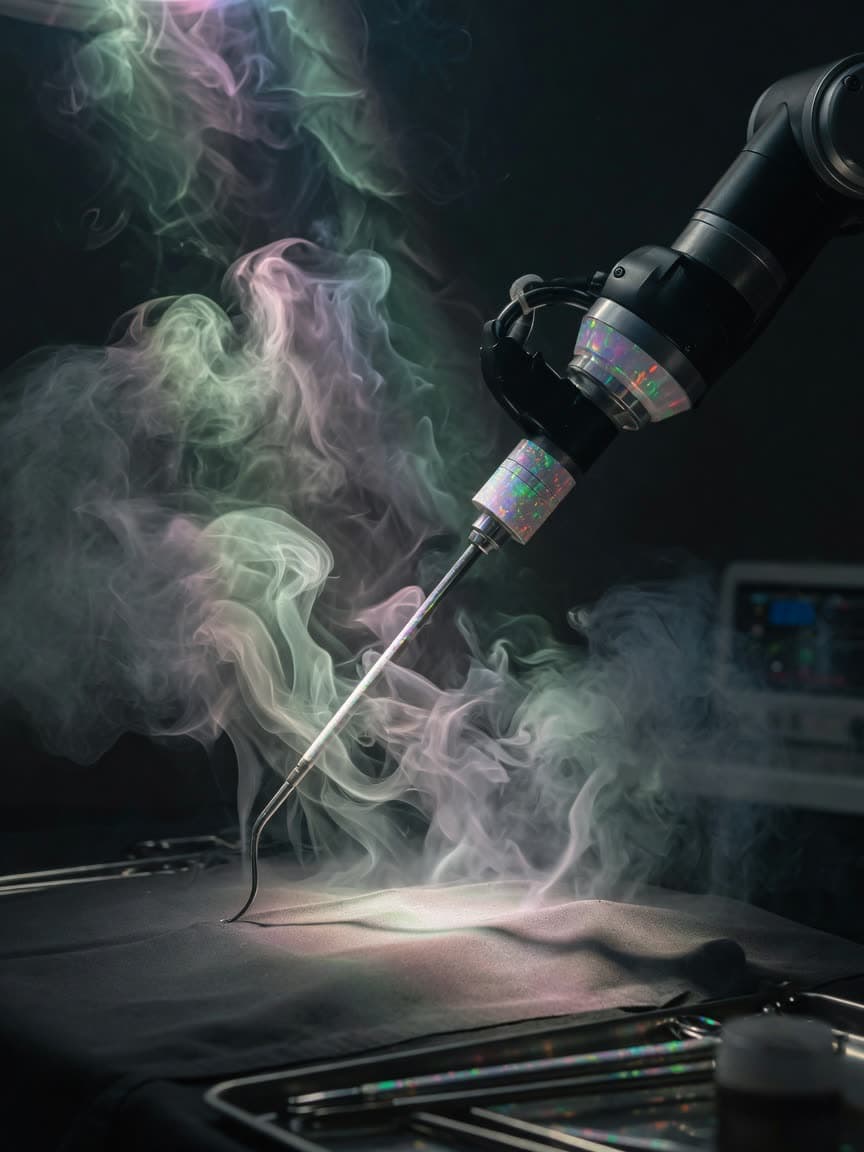
For two decades, Intuitive Surgical's da Vinci platform had the soft-tissue robotic surgery market essentially to itself. Then 2025 ended and 2026 opened like a deposition notice: Medtronic's Hugo received FDA clearance in December, Johnson & Johnson submitted its Ottava system for de novo approval in January, and CMR Surgical's Versius Plus landed US market access shortly after. Intuitive is now fighting on three fronts while simultaneously trying to redefine what a surgical robot is supposed to do.
The answer it's betting on: act, not just assist.
Da Vinci 5 Is a Compute Platform in Scrubs
The da Vinci 5, launched commercially in 2024 and now accumulating significant install base at US health systems, is the clearest sign that Intuitive understands the competitive threat isn't only other robots — it's the software layer those robots might eventually run. The system ships with 10,000x the onboard computing power of its predecessor, force feedback for the first time in the platform's history, and a rolling update cadence that has already pushed more than 100 feature drops to deployed units.
That compute headroom isn't incidental. It's the runway for what Intuitive — and frankly every serious player in this space — is actually building toward: surgical AI that can execute subtasks without waiting for the surgeon to physically drive every millimeter of instrument travel.
"Surgeon autonomy" is the polite framing. The destination is procedural autonomy — a system that can close a vessel or complete an anastomosis to a defined standard, supervised but not hand-held.
Right now, the FDA's own systematic review of cleared surgical robots puts 86% of them at Level 1 autonomy (robot moves, human fully controls), with only a handful reaching Level 3 (conditional autonomy for discrete tasks). Nothing at Level 4 or 5 has cleared for clinical deployment. That regulatory gap is not a technology problem anymore. SutureBot — a benchmark framework built on the da Vinci Research Kit — demonstrated end-to-end autonomous suturing in simulation. SutureAgent, published in early 2026, showed goal-conditioned offline reinforcement learning completing surgical trajectories in pixel space. The pipeline exists. The clearance pathway does not, yet.
The Autonomy Ceiling Is a Regulatory Architecture Problem
The FDA's January 2025 draft guidance on AI-enabled Device Software Functions introduced a Total Product Life Cycle framework that requires model descriptions, data lineage, bias analysis, and documented human-AI workflow handoffs. The 2026 finalization of that guidance is expected to set the actual bar for what it takes to bring a Level 3+ surgical AI agent to market.
That matters because the competitive landscape is no longer just about which robot a hospital buys — it's about which software platform gets to run in that robot. Intuitive has the data advantage: millions of logged procedures, instrument telemetry, and outcome records that no competitor can replicate from a standing start. Hugo and Ottava are chasing hardware parity. The real moat is the training corpus.
What hospitals are watching is whether outcome-based pricing structures emerge around AI-assisted procedures. The logic mirrors what Satya Nadella has been pushing in enterprise software: you don't pay for the robot, you pay for the result. Insurers are already piloting value-based contracts where certified AI systems tied to reduced complication rates trigger higher reimbursements. If that model scales, the surgical robot business stops being a capital equipment sale and becomes something closer to a per-procedure royalty — and the software layer becomes the margin.
The Competitive Stack Is Heating Up Fast
The new entrants aren't just competing on price. Medtronic's Hugo is modular and designed for smaller hospital footprints where a da Vinci installation is cost-prohibitive. CMR's Versius has been accumulating clinical data in Europe and India for years and arrived in the US with a meaningful evidence base. J&J's Ottava, still awaiting clearance, is designed from the ground up for multi-quadrant abdominal procedures — a direct strike at da Vinci's core urology and colorectal workflows.
Meanwhile, orthopedic robotics is running a parallel race. Stryker's Mako and Zimmer Biomet's ROSA are established. Newer entrants are targeting spine and extremity procedures with AI-guided implant positioning that adapts intraoperatively to patient anatomy deviating from preoperative imaging. The orthopedic space is arguably closer to meaningful autonomy than soft-tissue surgery because the operating environment is more constrained — bone doesn't move the way bowel does.
The unspoken benchmark in every robotics lab right now: can the system handle intraoperative surprise? Bleeding. Unexpected adhesions. Anatomy that doesn't match the scan.
Foundation models trained on surgical video are being developed specifically for this problem. A preprint published in May 2026 out of several academic medical centers described a specialized foundation model for "intelligent operating rooms" — a system that tracks instrument state, procedure phase, and team communication in real time to anticipate the next action and flag anomalies. It is not a surgeon replacement. It is an observability layer, and observability is how every complex autonomous system earns trust before it earns control.
What the Next 18 Months Actually Look Like
The FDA guidance finalization, expected by Q4 2026, will likely establish a provisional pathway for Level 3 autonomy — conditional, task-specific, with mandatory human override — for a narrow set of well-characterized procedures. Suturing and tissue approximation are the most likely first candidates because the benchmark data now exists to evaluate them.
Intuitive will move fastest on this because it has the data and the regulatory relationships. Hugo and Ottava will follow with their own AI layers, but they're building training sets from scratch. The hospitals that adopted early-generation robotic surgery in the 2010s are now facing a familiar decision: stay on the platform they know or bet on the new entrant that's promising a better software future.
The economics are shifting underneath the whole industry. Robotic surgery is projected to grow from roughly $8.9 billion in 2025 at a 13%+ CAGR — numbers that look modest until you layer in what happens to per-procedure revenue when the AI layer starts capturing outcome-based upside.
The humanoid robotics euphoria dominating the broader investment conversation — Morgan Stanley's $5 trillion market call, Jensen Huang cheerleading for Optimus — is partly a spillover effect from exactly this dynamic. The operating room is the highest-value, highest-consequence environment where physical AI has to work. If it works there, the argument for everything else gets a lot shorter.
The surgeons aren't going anywhere. But the robot is learning to close without being told to.