
The Deep Sea Is the Hardest Lighting Job on Earth
Below a thousand metres there is no sunlight, three quarters of the animals make their own, and the brightest thing in the water is usually the explorer. Designing light for the abyss means learning to see without being seen.
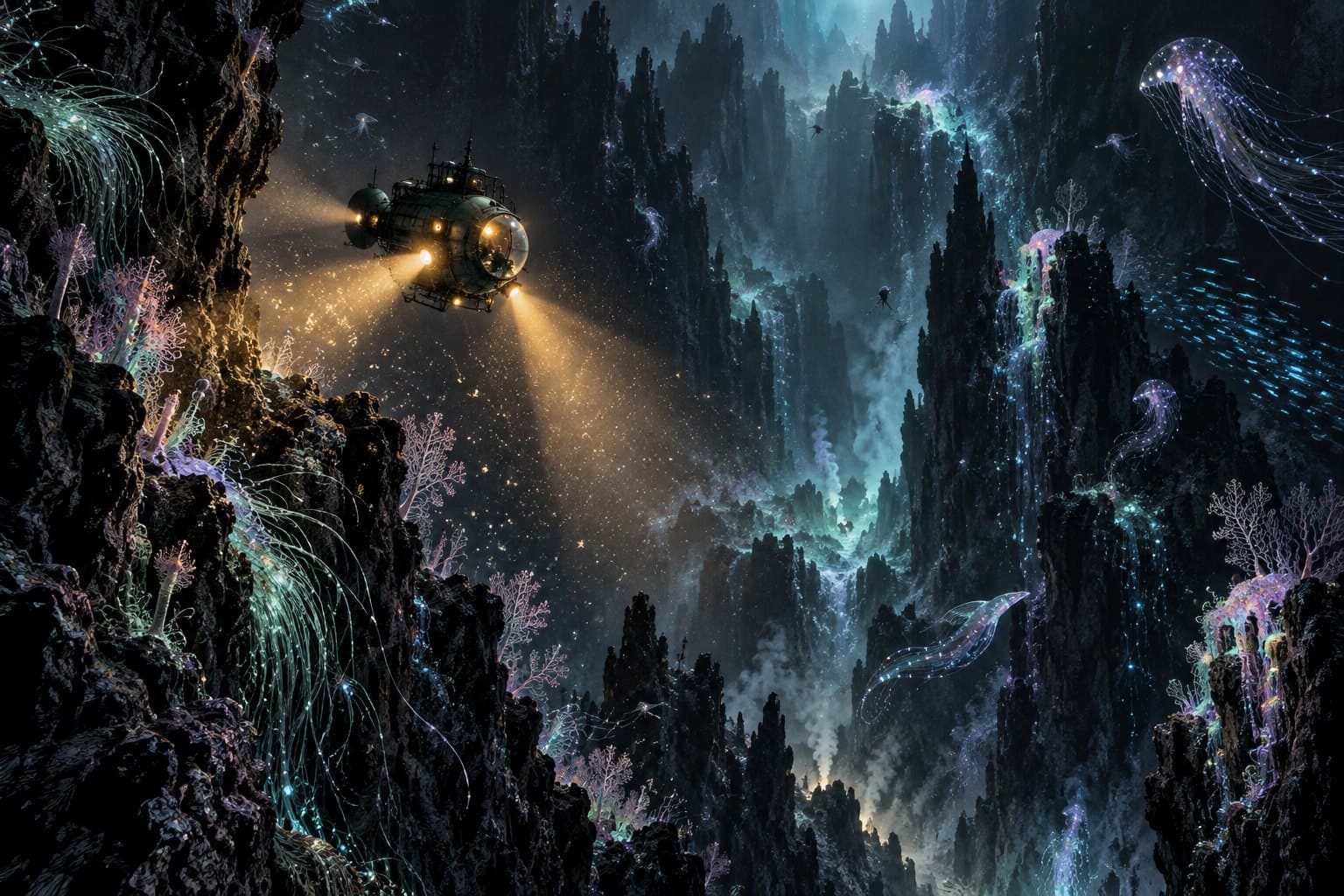
This summer, the research submersible Alvin reached 6,374 metres during sea trials after its routine overhaul, which happens roughly every five years, and on July 1 the Woods Hole Oceanographic Institution announced the U.S. Navy had cleared it to return to service, rated to 6,500 metres. Alvin has been taking people into the deep since 1964. WHOI says that depth puts roughly 99% of the global seafloor within reach.
Getting a three-person sphere to the bottom is an engineering triumph. Seeing anything once you get there is a design problem that is just as hard, and in some ways stranger.
A world where light is a language
Sunlight fades fast in seawater. Red goes first, within the top few tens of metres, then the rest of the spectrum thins out until, below about a thousand metres, there is effectively none left. Blue lasts longest, which is why the deep looks blue right before it looks black.
Life down there did not wait for the sun. In a 2017 study in Scientific Reports, MBARI researchers Séverine Martini and Steven Haddock analysed more than 350,000 observations from 17 years of remotely operated vehicle video off California, from the surface to 3,900 metres. They found that 76% of the animals they could classify were capable of bioluminescence, and that the share was remarkably steady with depth. Among jellyfish and their relatives, more than 97% glowed.
In other words, the deep ocean is not dark. It is full of signals: lures, warnings, camouflage, flashes that mean I'm here or eat him, not me. Most of those signals are blue, because blue travels furthest in water and many deep-sea eyes are tuned to it.
The problem with floodlights
Then we arrive, usually with very bright white lights.
For mapping a hydrothermal vent or collecting a rock sample, that is the right call. For watching animals behave naturally, it can be the worst possible approach. A burst of white light in a place where light means something is like walking into a quiet room with a siren. Many animals flee; others freeze. The footage shows a version of the deep that only exists while the lights are on.
There are also purely optical headaches. Water is full of drifting particles, called marine snow, that scatter light straight back into the lens. Underwater imaging engineers learned long ago to mount lights well away from the camera and angle them in from the side, so the brightest scatter falls outside the frame. Every deep vehicle you have ever seen with lamps on long arms is solving that geometry problem.
Seeing without being seen
The most elegant answer came from biologist Edith Widder, who built a camera system called Medusa around two ideas. First, illuminate with dim far-red light, around 690 nanometres, which most deep-sea animals cannot see. Second, instead of chasing animals, invite them: a ring of blue LEDs called the e-jelly mimics the "burglar alarm" display of the jellyfish Atolla, which flashes when grabbed, as if calling a bigger predator to attack its attacker.
In 2012, off Japan's Ogasawara Islands, the system recorded the first video of a giant squid in its natural habitat. In June 2019, on only its fifth deployment in the Gulf of Mexico, about 100 miles southeast of New Orleans, it filmed a juvenile giant squid in U.S. waters for the first time, approaching the lure and then retreating. Thousands of ROV and submersible dives in the Gulf had not managed that. The researchers' conclusion was blunt: the animal probably does not like bright lights.
It is a lovely piece of design thinking. The breakthrough was not a brighter lamp or a sharper sensor. It was working out what the audience could perceive and designing around it.
Light as character
There is a reason the image of a small craft hanging in the dark, two cones of warm light reaching down into a canyon, keeps showing up in art and film. It captures something true about exploration: we only ever see the slice of the world we bring light to, and the light itself changes what we find.
That is as much a lesson for interface designers as for oceanographers. The best tools often work like Medusa does. They get out of the way, use the subtlest signal that will do the job, and let the subject behave like itself.
What comes next
Upgraded vehicles like Alvin, stealthier cameras and better low-light sensors are pushing in the same direction: longer looks, gentler light, fewer assumptions. The deep ocean remains one of the least-observed places on the planet, and much of what lives there has still only been seen for a few seconds, in a beam it did not ask for.
The next great discovery down there may come from whoever learns to turn the lights down.
Two little submersibles, two warm beams, one very deep canyon: that is the scene on our Abyss Lights tee at AERIOX.